Saturday, April 30, 2011

The Return of a Jewel

While walking in Wildwood recently, I saw my friend Clyde Kessler. As we wandered, talking and listening for birds, he showed me an area where he had found a couple of foamflower plants about ten years ago and asked me to help him hunt. He had not seen any signs of the plants for three or four years. Well, I didn't know what they looked like, so I wasn't much help and we soon gave up. The following Saturday, I received an email from him saying that he had found the white flowers in full bloom. I grabbed my camera and headed out!


I could see that I was in for a treat - there were about a dozen plants (a welcome increase from the couple of ten years ago!) with white flowers spikes rising above the floor of green. I began snapping lots of photos and getting a closer look.


The Latin name for the plant is Tiarella cordifolia. The word tiarella means little tiara or crown, and the blooms certainly rival any of the jewelry adorning the queens and princesses seen in the media at the royal wedding this weekend.


I can imagine that a fairy princess might choose one of these sparkling flowers for a crown. As with most wildflowers, foamflowers have a variety of common names: heartleaf foamflower (The leaves do not look heart-shaped to me!), false miterwort (The leaves of this plant look very much like miterwort leaves), sugar scoop (Clyde's favorite), coolwort, and Allegheny foamflower. Whatever the name, it is a lovely treasure and I feel very fortunate to have had my camera handy when I first saw its freshest flowers.
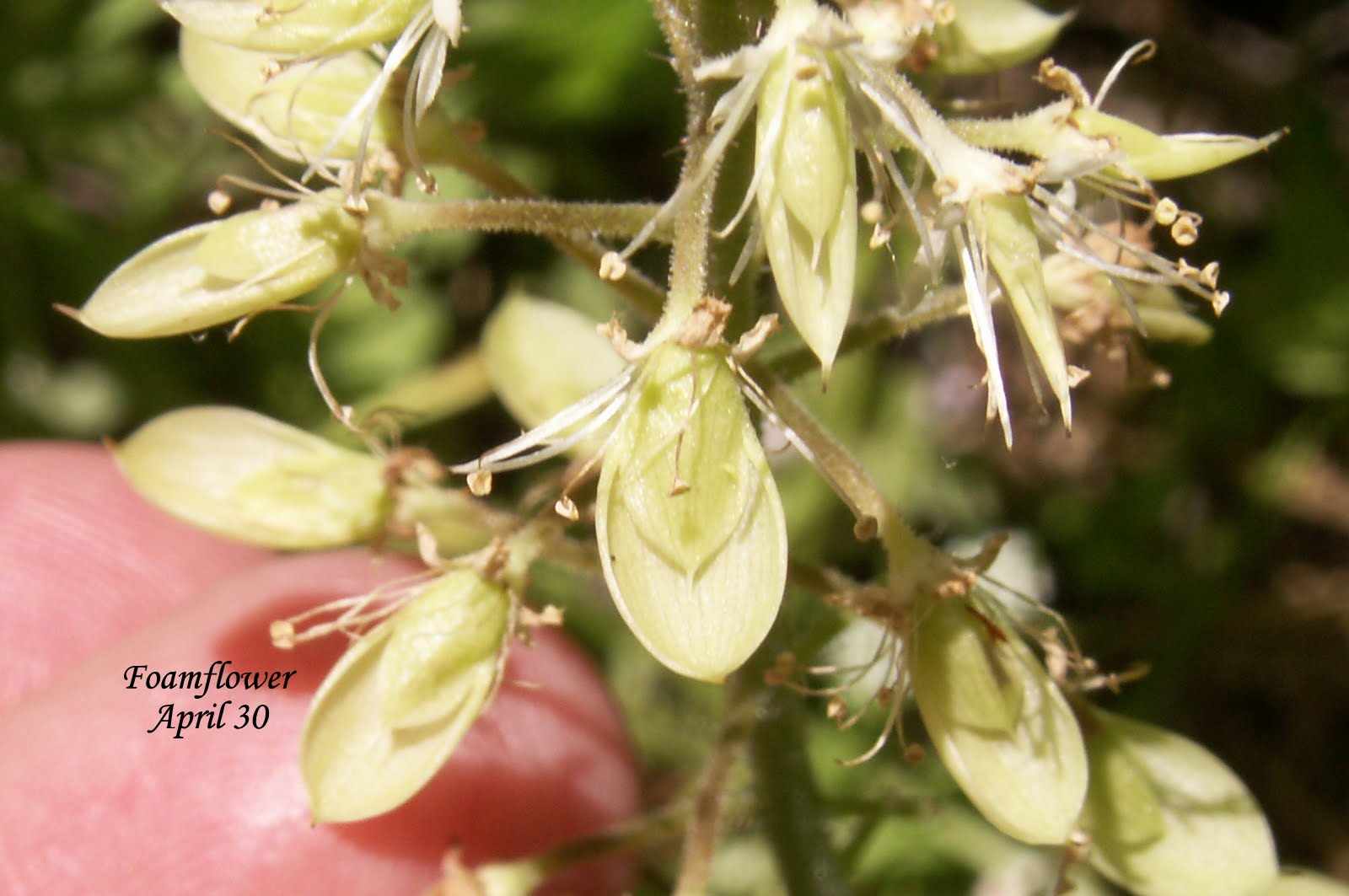


When I visited Wildwood today, I checked on the foamflowers. Many of them are bearing fruit now as the flowers drop off. Yes, Clyde, we can see where the sugar scoop name might have come from!

Monday, April 25, 2011

The Brown "Nut"

It was a cold and dreary day, but I was eager to get back to Wildwood after ten days in Wisconsin (where it was really cold!) visiting our grandchildren. After riding in our van for a day and a half, I needed to stretch my legs and breathe fresh air.
I began my short hike at the south end of the park and walked briskly along the bike path, soon reaching the wetland near the Main Street entrance. My camera had stayed snugly tucked in its case because a mist of rain had begun shortly after I arrived at Wildwood, and my hands were too cold to press buttons. At the water's edge, I saw a few large dandelions looking like sunbeams in the grass and plants. I also noticed a medium sized brown nut among the flowers. I knew that there were no nut trees in the area so I stooped down to get a closer look and saw a slug curled over an unopened bloom. Out came my camera - I couldn't leave Wildwood without a few photos!


The slug slowly stretched out, and I continued snapping. I watched it stretch out its tentacles to explore its surroundings.  


     The rain and mist left beads of water on the jewelweed seedlings that were also beginning to sprout.


As I reflect on that moment, I realize that unpleasant weather had drawn me to a lovely creature that I probably would have overlooked if other flowers and critters had been more abundant and I had been taking lots of pictures. And yes, I do think that the slug has a peculiar beauty of its own.   

Sunday, March 20, 2011

Going Batty!

I was enjoying a warm spring day in Wildwood last Saturday, walking along the bike path when I saw a bird flutter across in front of me. "That bird sure has a "fluttery" way of flying," I  thought. Then it landed on a tree trunk, and I saw that it was small and brown - "maybe a brown creeper," I thought.


The "bird" didn't move - seemed stuck to the tree, and suddenly I realized that it was a bat! I moved closer to the tree and began taking photos, getting a closer look at the tiny, furry creature. Its head stayed tucked into its feet as it clung to the bark. Its fur was shiny in the sunlight, and its ears were even shinier.


I sent the photo to Gary Cote, the webmaster for the Wildwood website and Biology professor at RU. He forwarded it on to Karen Francl, the bat expert at RU. She says that it is a Big Brown Bat (Eptesicus fuscus). She also said that the bat looked very healthy and that it isn't unusual for bats to go foraging for food on warm days although we usually consider them to be nocturnal animals. I guess they enjoy the warm spring weather as much as we do!


The bat had chosen a tree that was directly across from Adams Cave , which is probably is its home. The cave overlooks the south end of the park, and the creek runs below it, providing a source of water and insects for food for the flying mammals. A few days later, I again saw a bat flying near that same area. As it flew against the bright sky, I could see the outline of its bones through its wings and could also see the silhouette of its tiny ears and nose. A magnificent sight that I had never seen before - isn't Wildwood  wonderful!  


Friday, March 4, 2011

Coltsfoot (Tussilago farfara)

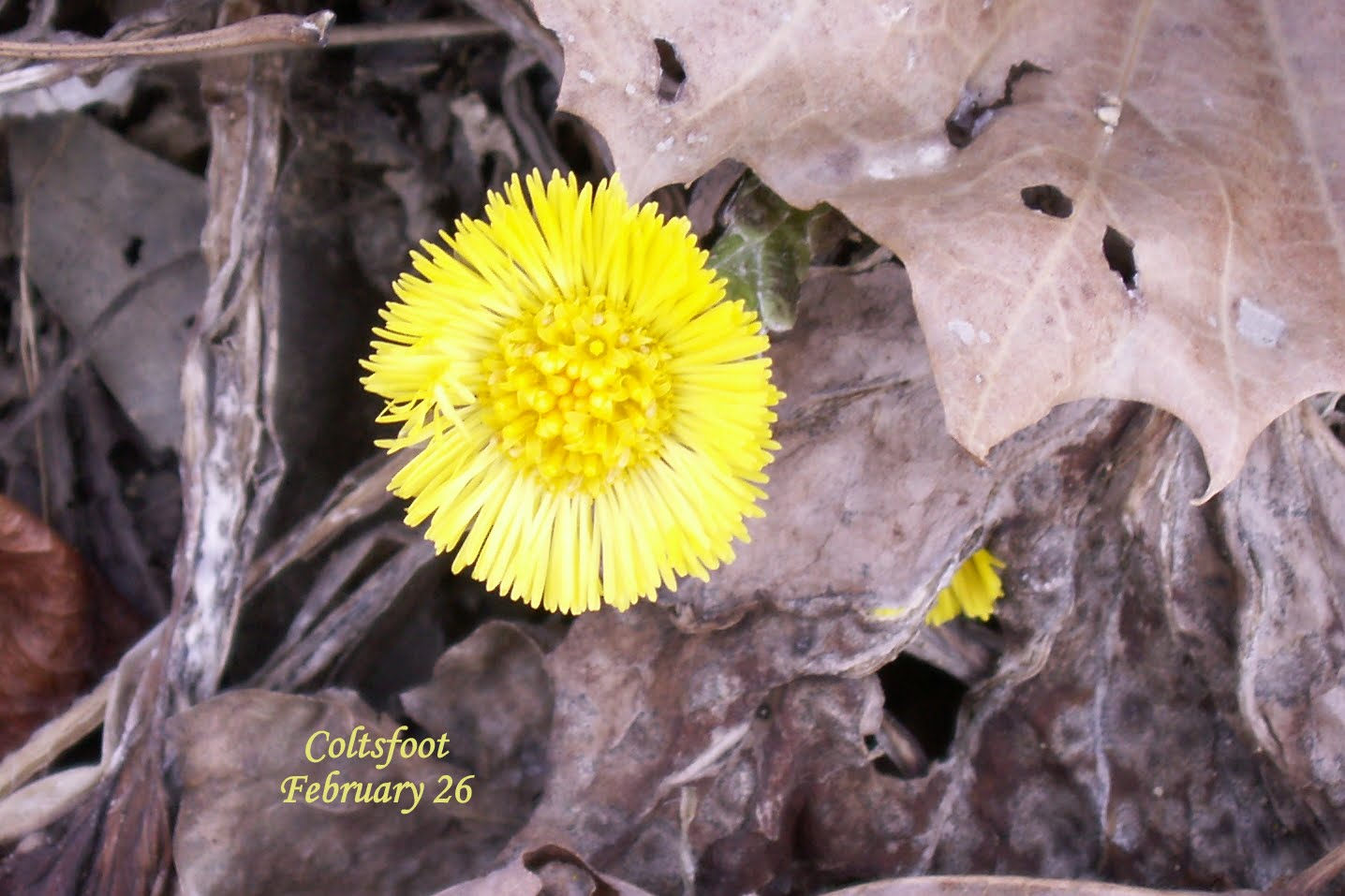
Coltsfoot - how's that for a wildflower's name!
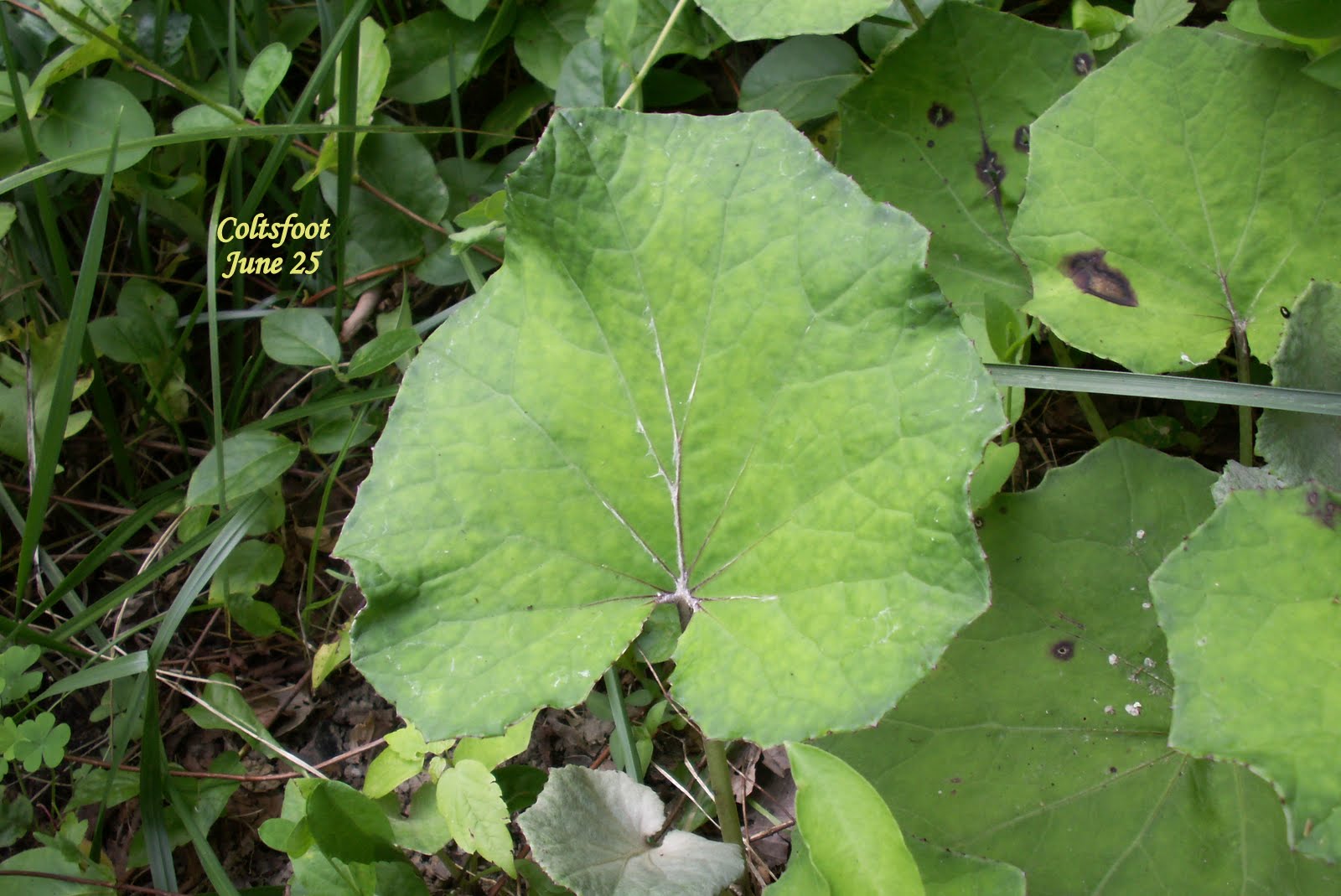
The name is actually a description of its leaf 
which does not appear until after the flower blooms.
Do you see how the leaf is shaped like the hoof of a small horse or colt?


Coltsfoot is blooming now in Wildwood and is bright enough and large
enough to be easily seen.
Do you see a flower that is trying to hide behind a leaf in the photo below?


You might mistake coltsfoot for dandelion which will be blooming later.
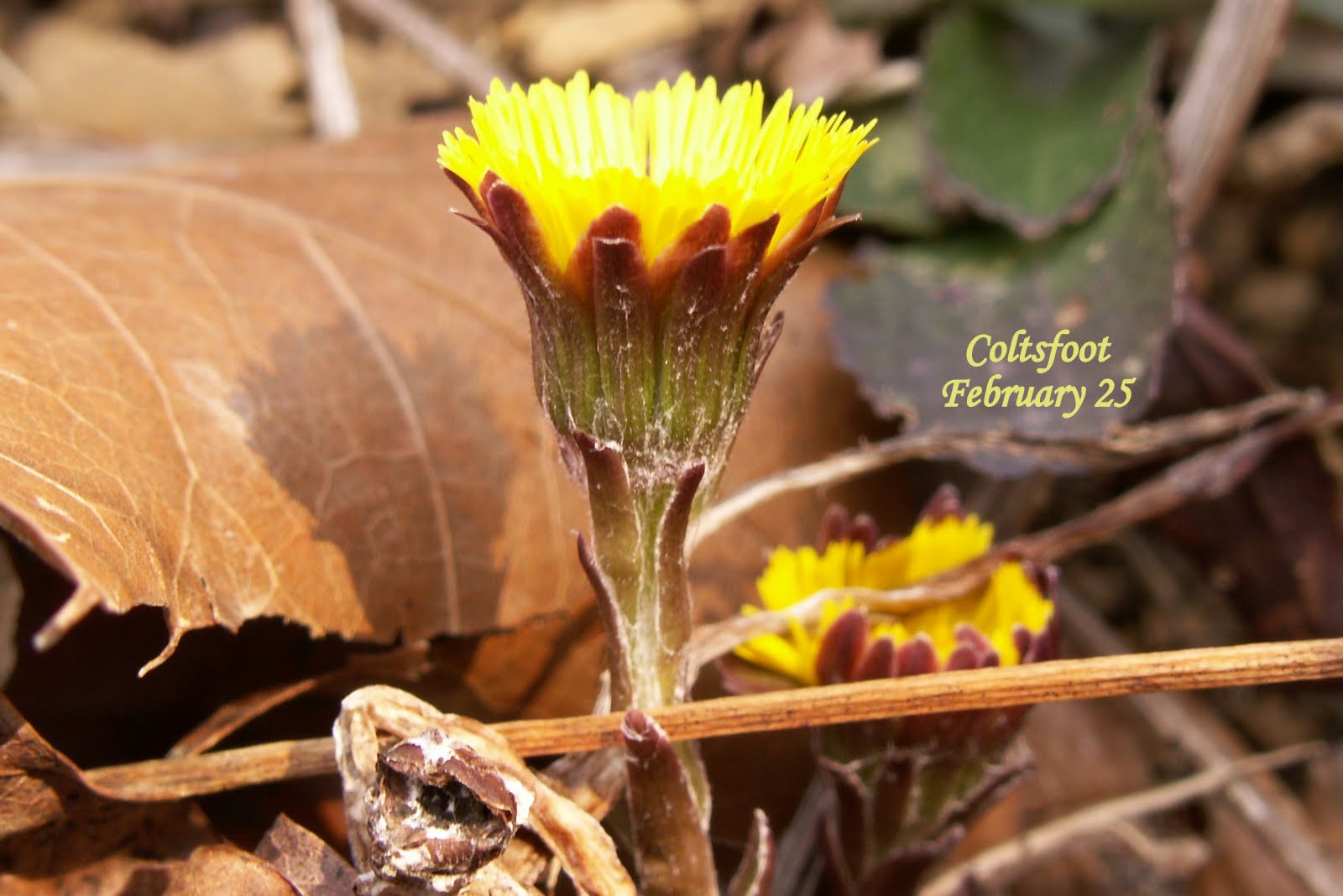
However, if you carefully take a look at the backside of coltsfoot, you will see that it
is a reddish color and not at all like a dandelion.


Colstfoot will try to fool you again when its seed puffs form in April.
It tries to look like dandelion again. How do you think the seeds might spread?


Look for coltsfoot the next time you walk though Wildwood.


 SEVERAL NEW POSTS HAVE BEEN MADE IN MARCH.
BE SURE TO SCROLL DOWN TO VIEW THEM ALL!

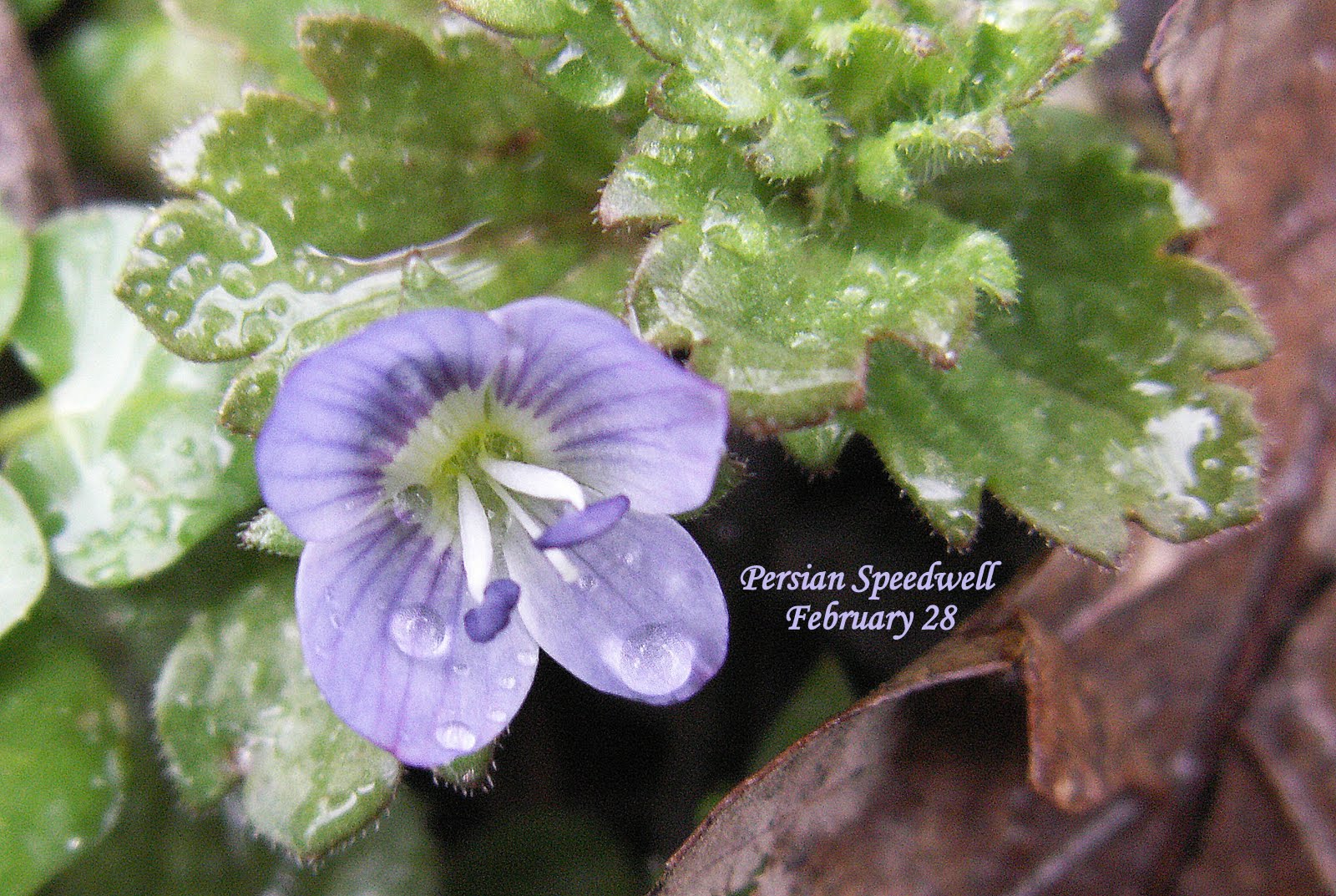
Persian Speedwell

One of the first signs of spring in Wildwood is often overlooked.
It is tiny and underfoot.
A close-up photo makes you think that it is large but,
don't let the camera fool you!


Persian speedwell (Veronica persica) is a ground cover that is plentiful in Wildwood.
It blooms along the bike path, in grassy areas, and almost anywhere there
is enough sunshine for it to flower. Another speedwell that is similar to it 
is called ivy-leaved. You have to take a close look to see the differences between them.
(Be sure to notice the leaves.)


Ivy-leaved Speedwell (Veronica hederifolia) will soon also be flowering.
When looking for spring flowers, be sure to take a close look at the
tiny flowers as well as the showy ones.
Carry a magnifying glass with you!


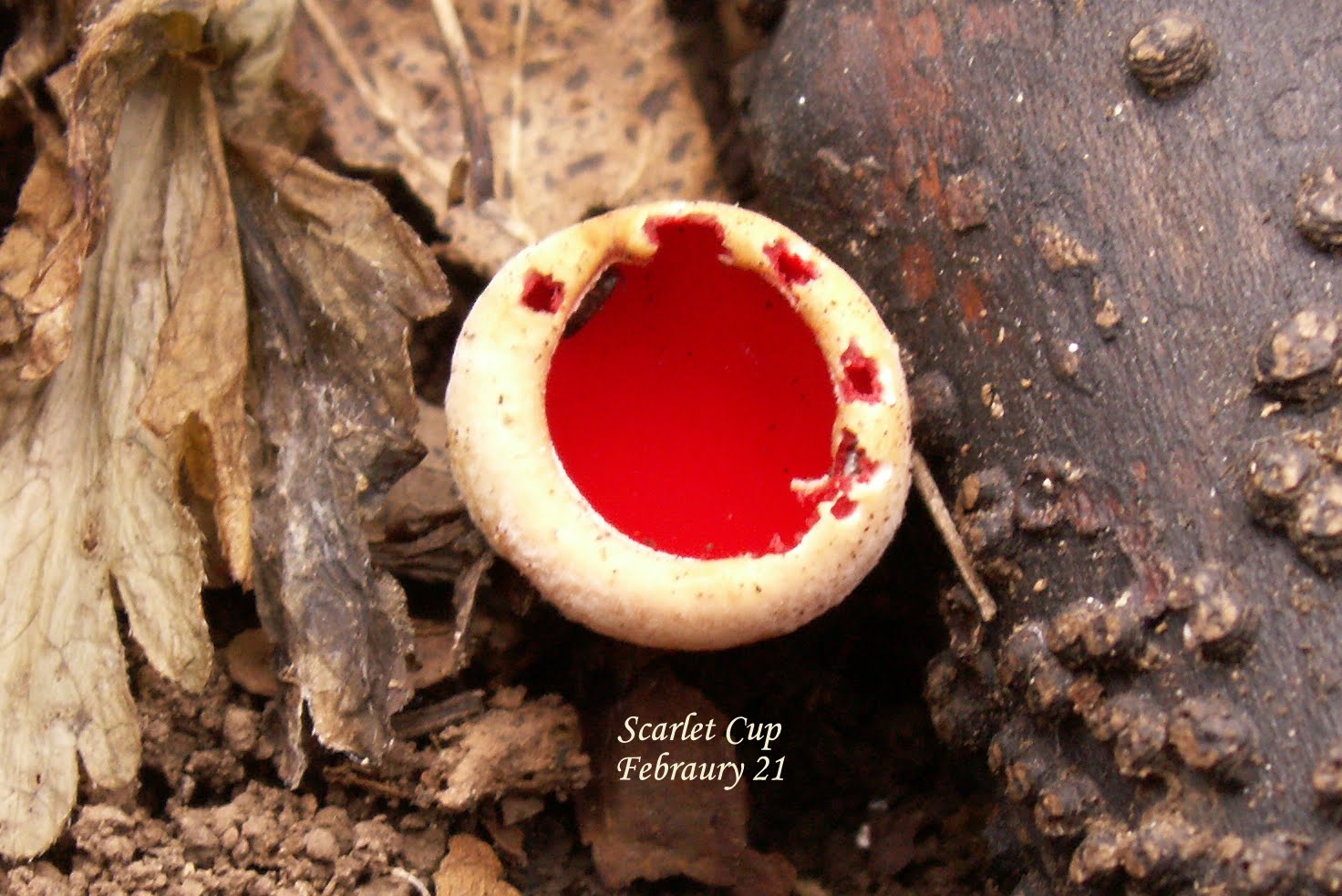
Scarlet Cups

Scarlet cups are a new spring organism for me in Wildwood.
They are very small - about the size of a dime when they first appear,
and they don't just pop up, you have to gently move a few leaves
to find them. That's probably why I had not seen them.
The cups are rather shallow, and although they look as if
they are filled with a shiny red liquid, they are actually dry inside.
 
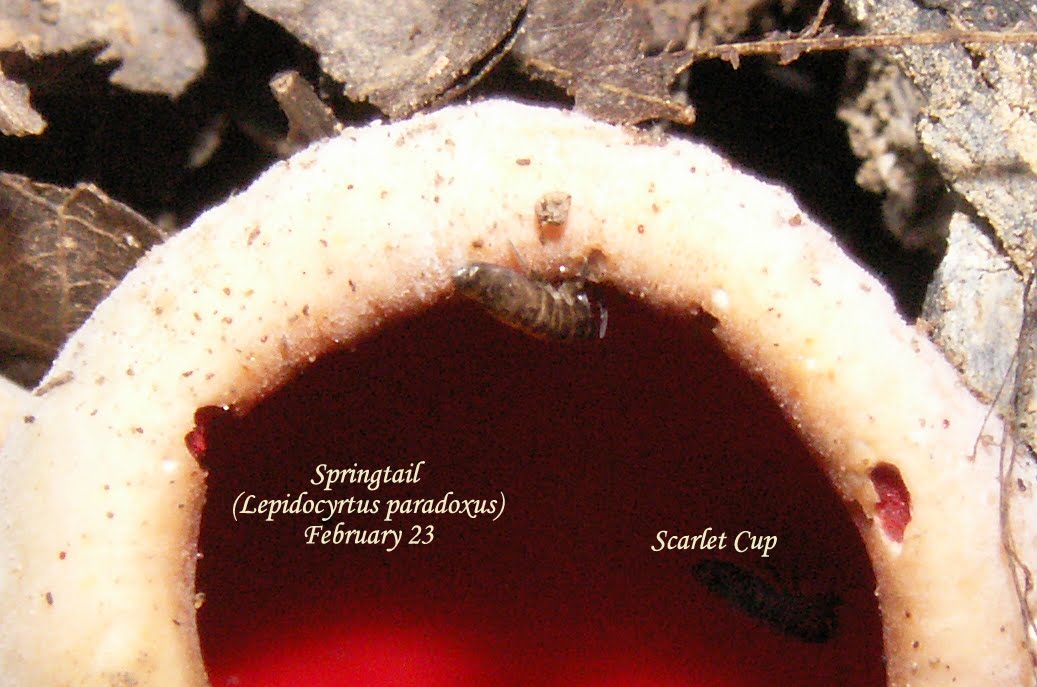
While getting up-close photos of them, I realized that there were
tiny, gnat-sized insects crawling on them called springtails.
I had not ever seen those, either!


When I returned to the site about a week later,
I found that the cups had grown and some were almost
as large as half dollars, and they were much easier to spot.


These are sometimes called scarlet elf cups and it's easy to imagine
that pixies and fairies might have tea parties in the woods where they grow!


Tuesday, March 1, 2011

Winter Firefly in Wildwood

Photograph © 2011, John Ford
I know that when someone mentions fireflies most people automatically think of balmy summer evenings with children chasing little sparkling lights around the yard squealing with glee whenever they manage to catch one. However, some of the members of the firefly family (Lampyridae) have different ideas about what constitutes a good time to be out roaming about.

I spotted this little guy (a Winter Firefly - Ellychnia corrusca) sunning himself in the early afternoon on February 6th on the west side of a relatively mature Yellow Buckeye (Aesculus flava) in Wildwood Park in Radford, Notice the relatively large cracks and bark scales in the bark; these are characteristic of mature trees of this species. They make great shelters for small critters that over winter here. Adults over winter for a single season in these protected areas on trees which are generally a foot or more off the ground and may be reused by subsequent generations.

Another thing that makes our little friend different than our summer fireflies is that he (or she) is a member of a group known as Diurnal Fireflies. These insects are active during the day rather than at night and spend their day light hours searching for food and mates. This is because while the larvae, pupae and newly emerged adults are capable of producing light; that ability is lost soon after emergence. Adults use pheromones to locate potential mates rather than the species specific rhythms of blinking lights which their nighttime cousins use.

By John Ford