Wednesday, July 27, 2011

One Wonderful Hour in Wildwood

After missing a couple of days in Wildwood, I returned on Monday afternoon, entering at the Main Street entrance. I have learned that I need to get my camera out of its case before I get out of the car so that I don't miss a good photo op. As soon as I got around the gate, I was greeted by a fresh and lovely Eastern Tiger Swallowtail (Papilo glaucus). It fluttered up to the top of a thistle plant that was higher than my head and tip-toed across the flower.


While I was shooting the butterfly, a humming bird almost bumped my nose with its beak - I don't know who was more surprised by that! Eastern Tigers have a wingspan of over four inches, and they are also Virginia's  official state insect.
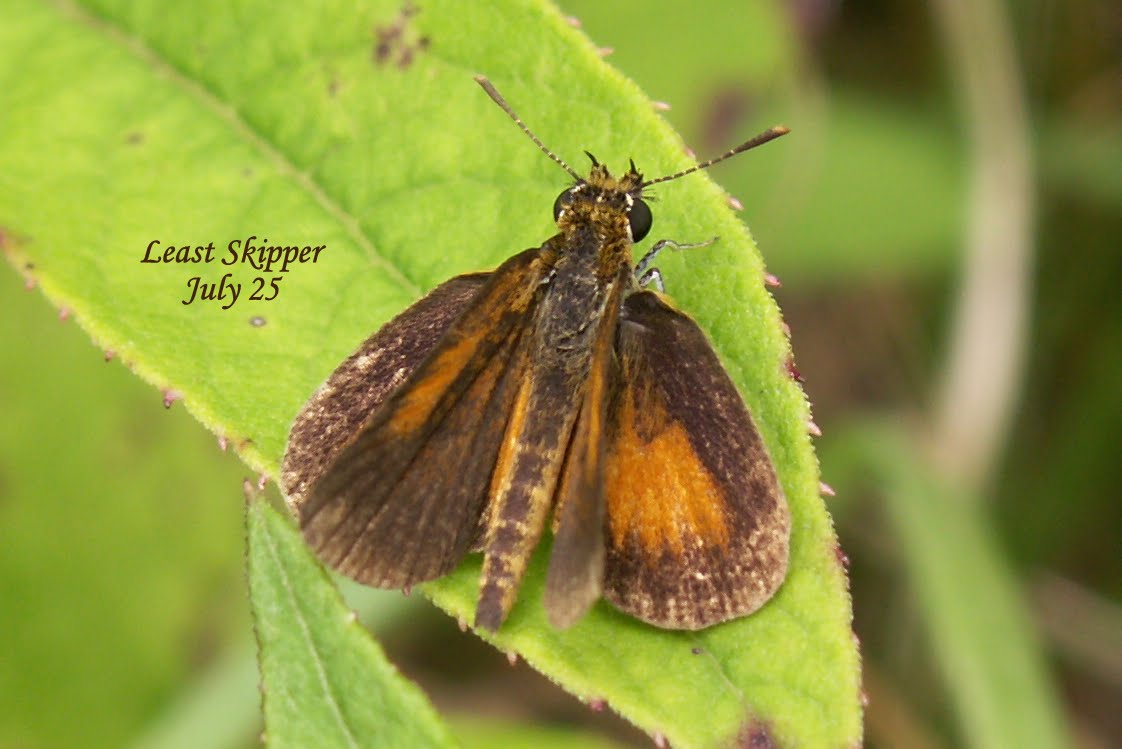
I moved on around the wetland area and immediately saw a tiny flutter near my boot tops - Virginia's smallest butterfly, a Least Skipper ( Anclyoxypha numitor) was resting on a plant stem.


The tiny wings glow like bright orange sparkles in sunlight and this one even opened its wings to reveal the top side of those wings -  a sight that I had never seen before!
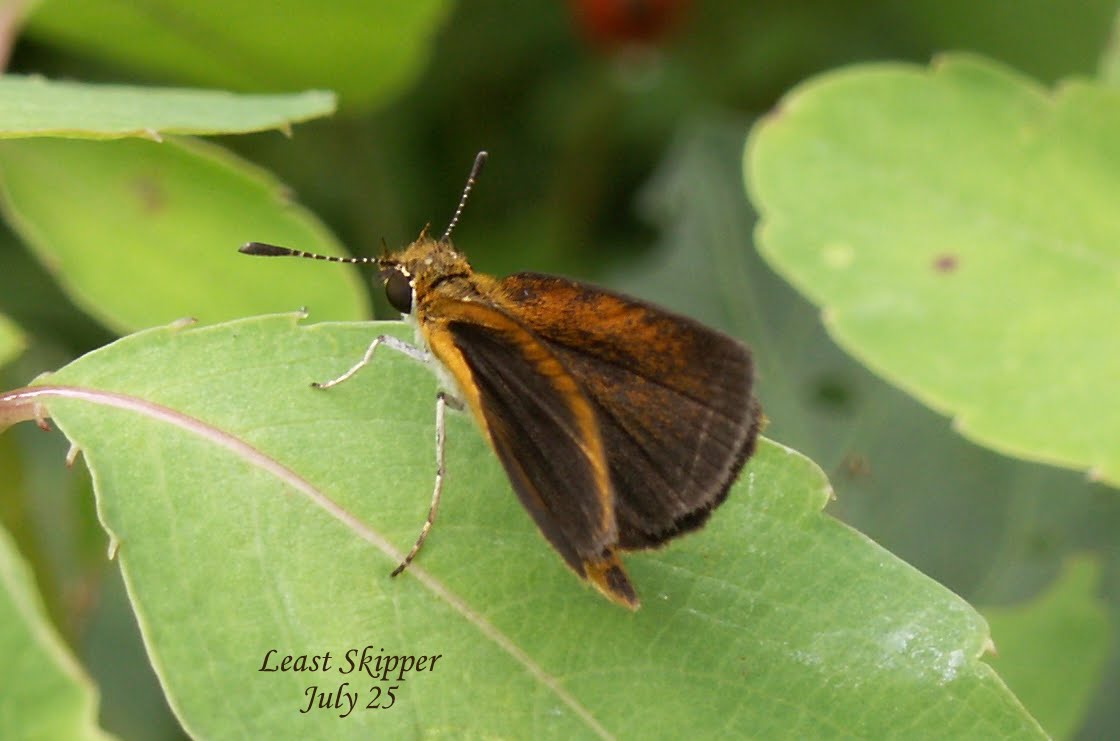


      And another later opened its wings even more. Ah, I saw some orange on the topside, also.


On a nearby leaf of bittersweet nightshade, my camera found an old friend - a Tater Bug (Leptinotarsa juncta) also known as a False Potato Beetle. Its handsome colors make it very photogenic.


Just above the Nighshade on a leaf of the taller Jewelweed , a Variable Dancer (Agria fummipennis) paused long enough for me to get a quick shot. It had a rich purple color in the filtered sunlight.


Moving on across the wetland, I soon spotted my newest favorite butterfly - a Giant Swallowtail (Papilo cresphotes). I really get excited when I see one of those - the wingspan can be as much as 5 1/2 inches. It's easy to see why it is one of the largest butterflies in North America. Until Monday, I hadn't gotten a very good look at those yellow underwings.


Earlier I had seen its rich chocolate brown upper wings and as it fluttered on the swamp milkweed flowers, I could get glimpses of each side all in one lively blur. I could even see the yellow "eye" on the tip of its tail and could hear the soft flap of its huge wings. 


 As I watched, another Giant joined the first, then another, and another - four in all! What an aerial show!
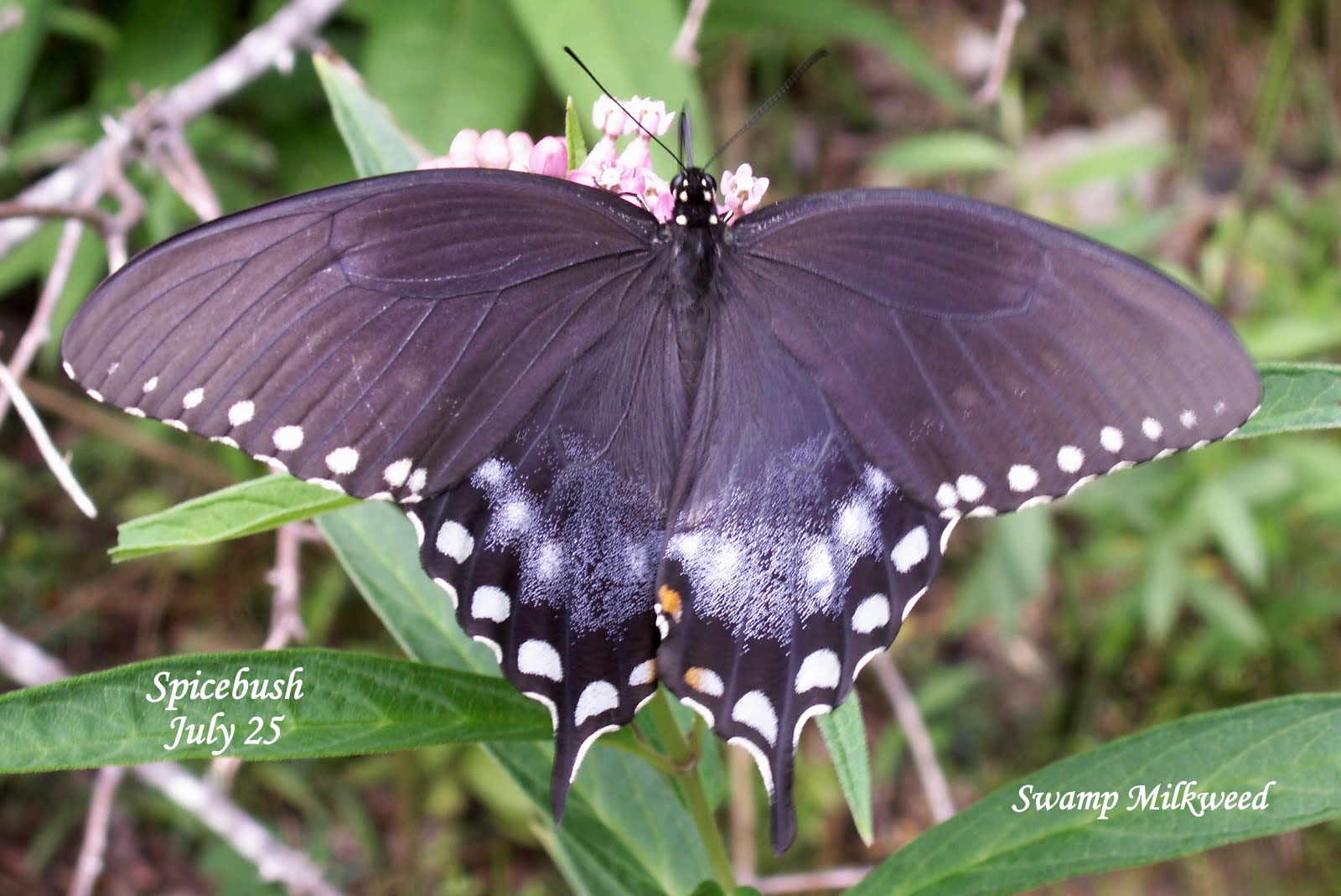
I eventually put my camera aside and just enjoyed the moment. A humming bird - perhaps the one that had almost collided with me - flew through the twirling butterflies, scattering them back to the flowers. I opened my camera again to capture the latest addition to the scene - a Spicebush Swallowtail (Papilo troilus).


Butterflies love Swamp Milkweed and so do tiny Swamp Milkweed Leaf Beetle larvae. While standing very close to a leaf, I saw one of those dear little creatures crawling slowly along a leaf and a stem. Slow crawlers help make good photos. Is that a shy smile that I see?


Just before storm clouds gathered enough to begin a sprinkle of rain and send me home to my husband Lou and the welcome dinner he usually has prepared for me, I reflected on the joyous hour I had spent with the Wildwood visitors and dwellers, and I knew that I could relive it in my mind with the help of my photographs. How privileged I felt...








Wednesday, July 20, 2011

GLEN ALTON OUTING


At this pond, you can often see many species of dragonfly. Today we saw few, but the snag trees were busy with birds, including hummers bossing everything around. Photo © Ray Callahan


A cloudy day, but an enjoyable, early morning trip to Glen Alton. Photo © Ray Callahan

Saturday morning (July 16th)at Glen Alton was cloudy and rather cool, relative to the hot weather of the last few days. It was cool enough that few insects were flying. Exceptions were bumblebees and they were everywhere even nectaring on plantain flowers.

Ray Callahan and I visited there to find dragonflies but found only two: a meadowhawk (Sympetrum) that was just emerging from the skin of its old nymph shell; and a female Blue Dasher (Pachydiplax longipennis). The Blue Dasher could barely fly because of the low temperature.

We did find a few species of damselfly:

Swamp Spreadwing (Lestes vigilax)
Aurora Damselfly (Chromagrion conditum)
Variable Dancer (Argia fumipennis)
Eastern Forktail (Ischnura verticalis)
Citrine Forktail (Ischnura hastata)

We saw only a few species of butterflies:

Eastern Tailed-Blue (Everes comyntas)
Northern Pearly-Eye (Enodia anthedon)
Common Wood-Nymph (Cercyonis pegala)

Birds were easy to locate, we found 45 species. Highlights included watching a pair of flickers feeding their babies. The young ones would stretch their heads slightly out of the nest cavity (in a large dead pine) and a parent would put food inside their mouths. Ruby-throated Hummingbirds were everywhere, saw twelve at least, probably a lot more. These were all crazy and feisty, diving at and chasing other birds from Scarlet Tanagers to Phoebes to warblers.

Glen Alton by the way is a great place for nature watching and discovery. It is located in Giles County. You can find five species of thrushes in nesting season: Eastern Bluebird, Veery, Hermit Thrush, Wood Thrush, & American Robin. Also Brown Creepers and Red-breasted Nuthatches are known to nest there. There are also scads of singing Blackburnian Warblers.

Many species of dragonfly and damselfly can be found there during the summer. Just not this morning.

Glen Alton is a great place for an easy stroll. There are several ponds for fishing. I plan on posting more about the place later this summer and fall. Stay tuned.


Appropriately enough several Barn Swallows would sally back and forth from this old barn. There were likely nests inside. Photo © Ray Callahan

Thursday, July 14, 2011

Drama in Wildwood

WARNING: If you are squeamish or terribly tender-hearted  stop reading now!
On Tuesday, I took my camera to the Eighth Avenue entrance of Wildwood. Skipper butterflies love the Everlasting Peas (Lathryus latifolius) that grow there and often come to nectar. As soon as I arrived at the area, a Red-spotted Purple (Limenitis arthemis) greeted me and agreed to pose for photos for a few minutes in the gravels of the road, its colors glowing in the sunlight.


I ambled on to see what I could find in the peas and in the Spotted Knapweed (Centaurea maculosa) that had started flowering. 
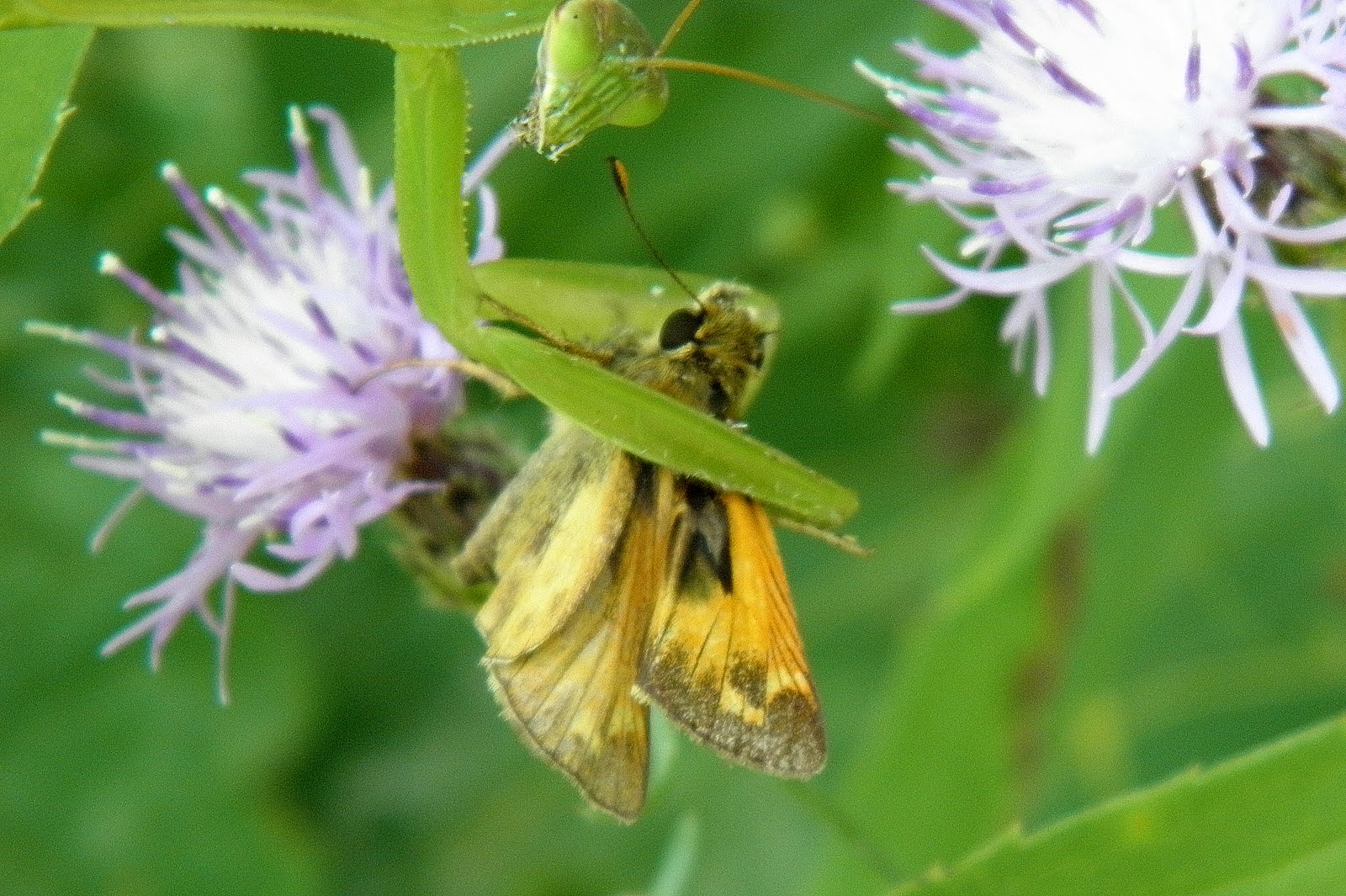
Almost immediately I saw a male Sachem Skipper (Atalopedes campestris) resting on a leaf. 


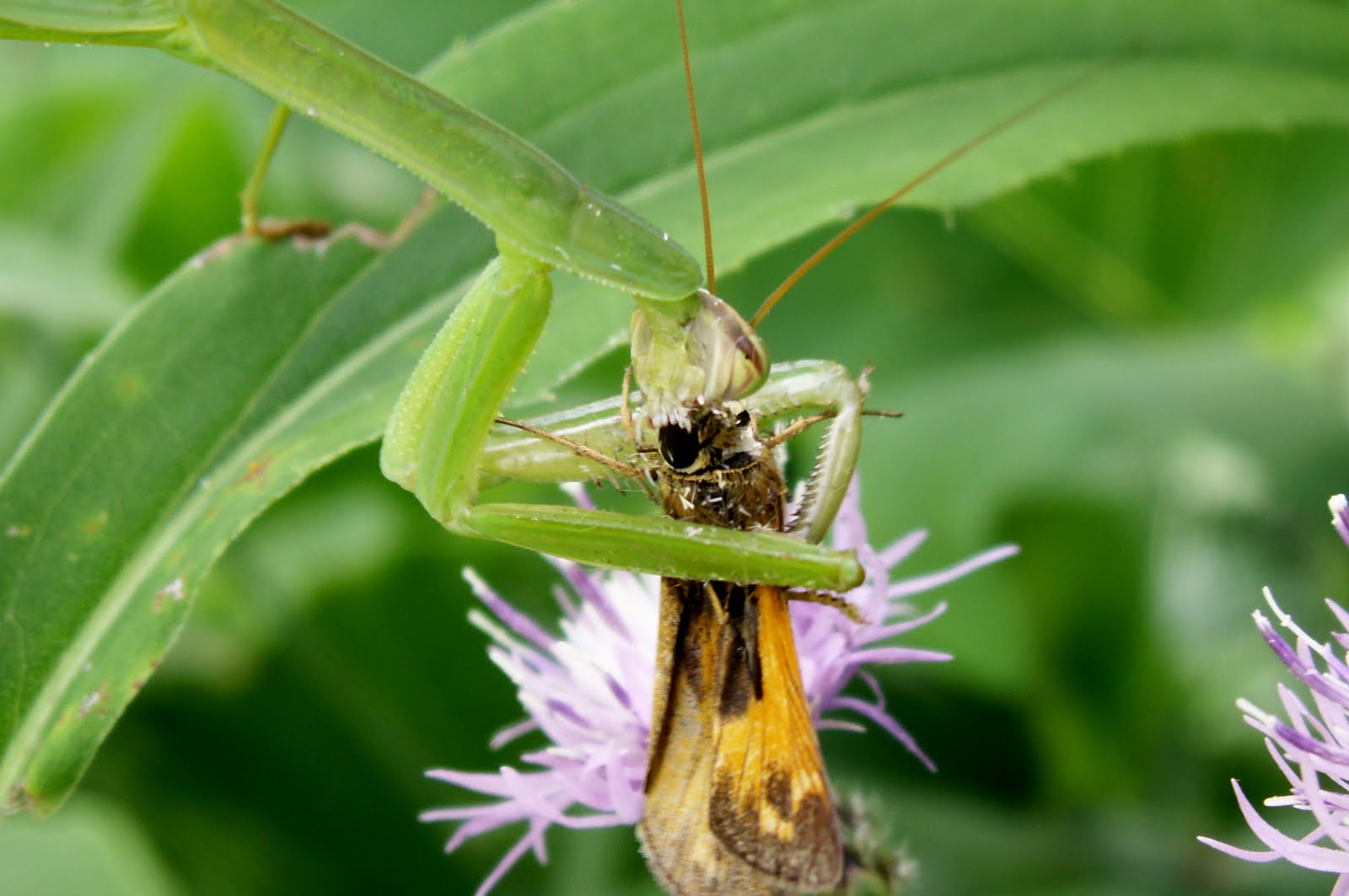
He soon fluttered off to find a bloom, and I followed him with my camera. But wait - there was a green leaf blocking his tiny wing. As I reached carefully for the "leaf", I discovered that it was a leg - and it belonged to a young praying mantis!!!

Oh, no! That dear little butterfly had been captured by a predator.


Amazed, I continued snapping pictures.


Although I was heart-broken for the victim, I knew that the captor needed a good lunch. 


Such is the paradox of nature. 

Wednesday, June 22, 2011

Welcome Back!

After traveling home yesterday from a short vacation in Richmond , I was eager to to get out to Wildwood with my camera. Actually, I'm usually eager to get out to Wildwood even when I've been at home! 
I began my walk in the Park at the Eighth Avenue entrance. The cell tower is up there and it's easy to make a quick check of what's happening in that open area. 
I soon began snapping photos of flowers and butterflies and bugs. One little brown butterfly gently fluttered by, stopped to rest in the grass, and allowed me to get close enough to take several shots. I did not recognize the species, and I wanted to get home to get a closer look at its image in my computer.
After dinner, I began my search. I soon realized that I had found an extremely rare critter that had made its home in Wildwood for at least eighteen years according to Clyde Kessler, who also confirmed my identification. These insects are also extremely local within their range. He had told me to be on the lookout for them, but we had not seen any at all last summer. We feared that aggressive spraying under the power lines might have harmed the insect or its habitat.What a joy to discover that our friends had only taken a year's vacation. Even a Northern Metalmark (Calephelis borealis) knows that Wildwood is a wonderful place!


The Northern Metalmark likes limestone and dolomite so the Elbrook Formation of Wildwood is a perfect place for the lovely creature's habitat. It loves to nectar on Butterflyweed but will be satisfied with Rosinweed, Oxeye Daisy, Mountain Mints, and such. For laying eggs and feeding larvae they need Ragworts (Packera) - particularly Round-leaf Ragwort (P. obovata) and Prairie Ragwort (P. plattensis). 
These plants grow in the Wildwood. 
Take a close look at the photo above. Can you see how the Metalmark got its name? Clyde says that when the sunlight catches their wings just right, the markings look to him like embossed silver threaded into the wings. They almost always land and perch with their wings open and flat so that getting a photo or even a look at their underwing is not easy. The mostly dark pattern allows them to be camouflaged and hidden from predators. They are reasonably calm when perched, so I was able to get my camera close and on the ground when one was perched on a low limestone rock and got the photos below of the light colored underwing as it slowly lifted itself on its four long back legs. Notice the two very short front legs - this is a characteristic of the male of this species. Females have two long front legs as well as four long back legs.


Now you can get a glimpse of the metal marks that give the butterfly its name. How about those compound eyes! Many insects use those as an excuse to dart away when a human puts a camera in their face. Love that calm...I snapped several shots and then wished that the critter would fold its wings up. It did raise them a bit, enough for me to feel successful with getting several views.


Metalmarks enjoy open glades, road cuts, power line cuts (without spray!), all with limestone soils. In most areas there is only one brood flying from mid June to mid July.
We must take care to guard the habitat of these small jewels and do all that is possible to ensure that they always find a comfortable and inviting home in Radford.
Welcome back to Wildwood, gentle friends!


Monday, May 30, 2011

...passing through...

Many people and animals pass through Wildwood Park on their way to another destination. On May 20, I was substitute teaching at Belle Heth Elementary School and had the pleasure of accompanying three third grade classes to Bisset Park so that they could meet their pen pals from Riverlawn Elementary School and get acquainted over a picnic lunch. Mrs. Woolwine knew that I would enjoy the day as much as her students. 
A police escort cleared the short stretch of Second Avenue and Park Road and met us at the school. Students were eager to have the opportunity to walk with me through the Park and see places that I had shown them in photographs.


Walking through the tunnel was quite a noisy time - imagine 60 nine-year-olds trying to out-scream each other. We arrived at Bisset  in time to play a while before our Pulaski County friends got there, but soon students were busy meeting each other, asking lots of questions as they ate lunch together.

Our police escort was called to see us safely out of the park and back up the hill to school. Their small electric car was even able to drive down the bike path to see where we were so that other police officers and regular cars would be ready to guard intersections for us. We declared the day a fun and successful outing!


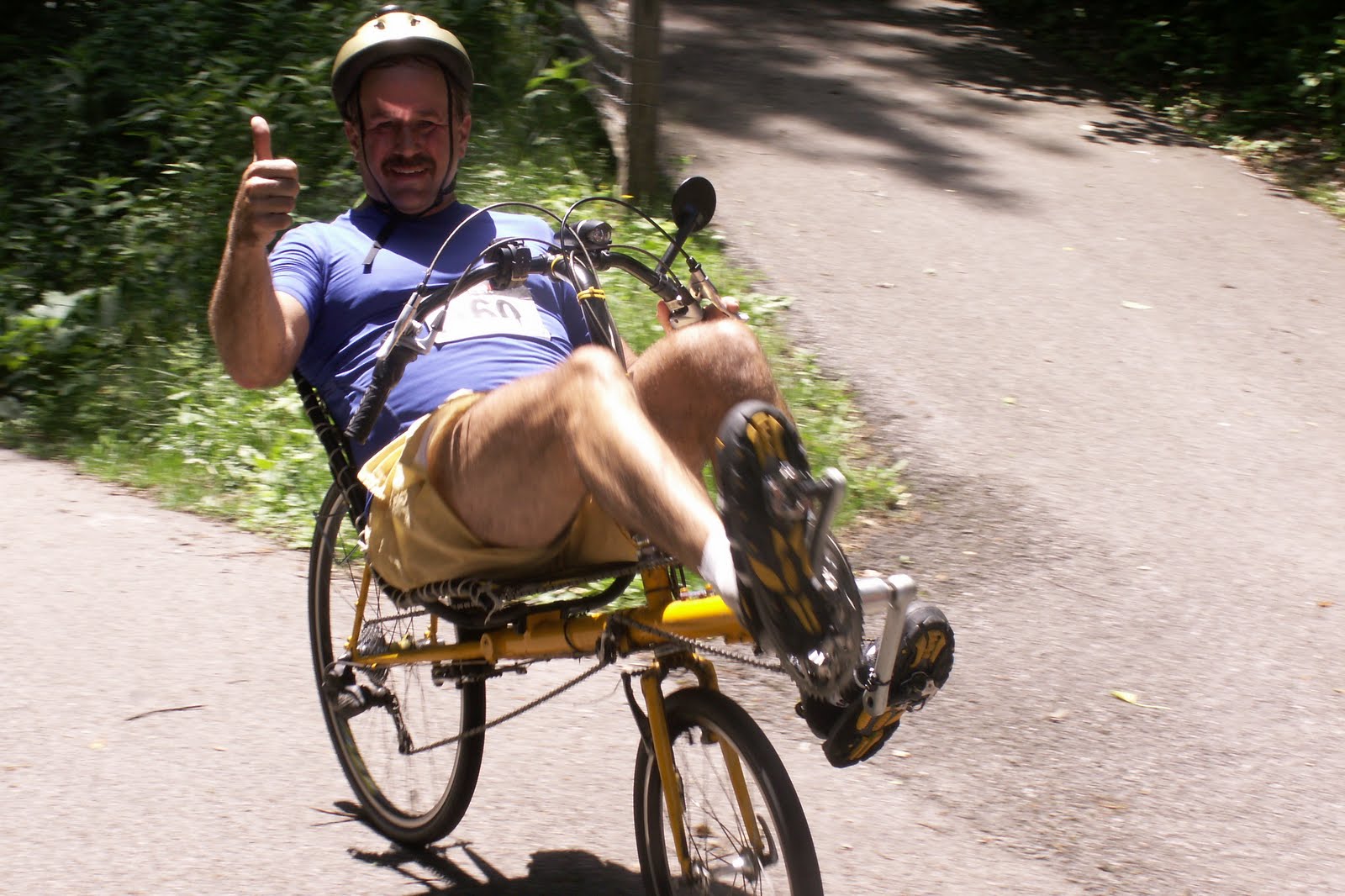
On Saturday, May 28, bike riders came through the Park as part of  the Wilderness Road Ride. Of course, I was there with my camera to see a few of the participants. Some whizzed by in a hurry. Perhaps riding in tandem allows you to ride faster?


                   Others were more leisurely. Can you guess what a recumbent bike is?


                    All of the bikers were glad to be coming to the end of their day's journey.


When I decided that I had taken enough pictures (Do I ever really take enough?!!) and needed to head home for lunch, I walked up to Main Street to take one more look down into the Park from above the tunnel. Imagine my surprise when I looked down the sidewalk and saw five horses coming along the walk with riders on two of them. Of course, I asked whether I could take photos, and the riders said, "Please do!" Chris and Shauna had begun traveling from Dallas, Texas, on March 8, 2011, and were on their way to New York City. They had decided to take the long journey to get attention for childhood cancer and hoped to raise $3,000.00 $1.00 for each mile of the round-trip) for Heroes for Children. They didn't actually pass through Wildwood but I thought that you would like to see them and  read about them.


NOTE: Be sure to take a look at the sidebar photos to see a few of the dogs that pass through the Park with their owners. Those dogs do their part to help keep their owners in shape!

Saturday, April 30, 2011

The Return of a Jewel

While walking in Wildwood recently, I saw my friend Clyde Kessler. As we wandered, talking and listening for birds, he showed me an area where he had found a couple of foamflower plants about ten years ago and asked me to help him hunt. He had not seen any signs of the plants for three or four years. Well, I didn't know what they looked like, so I wasn't much help and we soon gave up. The following Saturday, I received an email from him saying that he had found the white flowers in full bloom. I grabbed my camera and headed out!


I could see that I was in for a treat - there were about a dozen plants (a welcome increase from the couple of ten years ago!) with white flowers spikes rising above the floor of green. I began snapping lots of photos and getting a closer look.


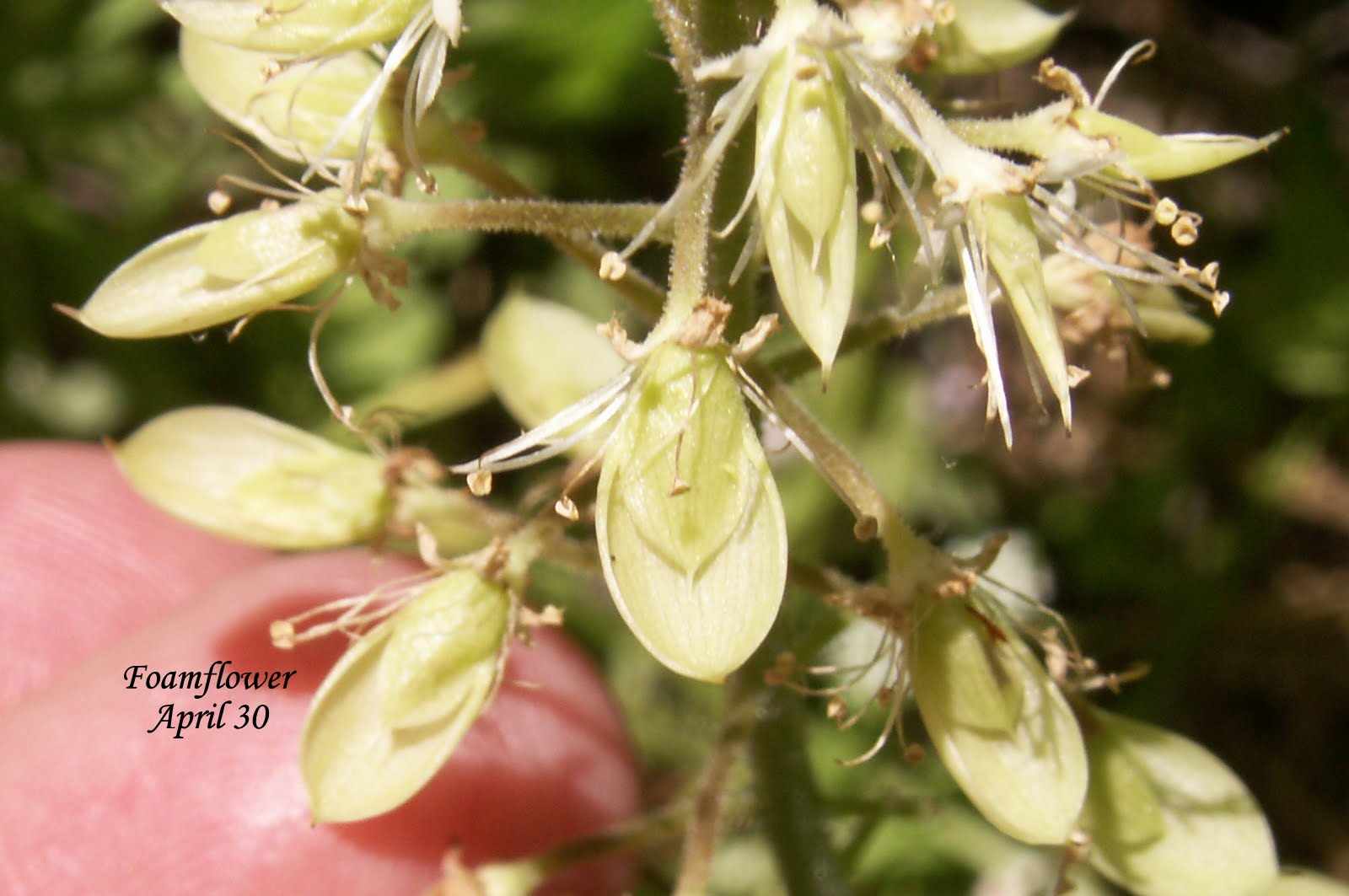
The Latin name for the plant is Tiarella cordifolia. The word tiarella means little tiara or crown, and the blooms certainly rival any of the jewelry adorning the queens and princesses seen in the media at the royal wedding this weekend.


I can imagine that a fairy princess might choose one of these sparkling flowers for a crown. As with most wildflowers, foamflowers have a variety of common names: heartleaf foamflower (The leaves do not look heart-shaped to me!), false miterwort (The leaves of this plant look very much like miterwort leaves), sugar scoop (Clyde's favorite), coolwort, and Allegheny foamflower. Whatever the name, it is a lovely treasure and I feel very fortunate to have had my camera handy when I first saw its freshest flowers.


When I visited Wildwood today, I checked on the foamflowers. Many of them are bearing fruit now as the flowers drop off. Yes, Clyde, we can see where the sugar scoop name might have come from!

Monday, April 25, 2011

The Brown "Nut"

It was a cold and dreary day, but I was eager to get back to Wildwood after ten days in Wisconsin (where it was really cold!) visiting our grandchildren. After riding in our van for a day and a half, I needed to stretch my legs and breathe fresh air.
I began my short hike at the south end of the park and walked briskly along the bike path, soon reaching the wetland near the Main Street entrance. My camera had stayed snugly tucked in its case because a mist of rain had begun shortly after I arrived at Wildwood, and my hands were too cold to press buttons. At the water's edge, I saw a few large dandelions looking like sunbeams in the grass and plants. I also noticed a medium sized brown nut among the flowers. I knew that there were no nut trees in the area so I stooped down to get a closer look and saw a slug curled over an unopened bloom. Out came my camera - I couldn't leave Wildwood without a few photos!


The slug slowly stretched out, and I continued snapping. I watched it stretch out its tentacles to explore its surroundings.  


     The rain and mist left beads of water on the jewelweed seedlings that were also beginning to sprout.


As I reflect on that moment, I realize that unpleasant weather had drawn me to a lovely creature that I probably would have overlooked if other flowers and critters had been more abundant and I had been taking lots of pictures. And yes, I do think that the slug has a peculiar beauty of its own.