Saturday, December 15, 2012

A Super Saturday Adventure!


                                  Clyde Kessler writes:
        November 17, Melanie Fox invited us over to her home in 
             Radford to watch the banding of two hummingbirds. A week 
      earlier she had emailed me photos she had taken of two 
        hummingbirds at the hummingbird feeder in her front yard.


                                        Mel had also told me that during the cold spell that had 
                                     started a few days early, the feeder’s nectar (sugar water) 
                                        would partially freeze up. So she started bringing the 
                                        feeder in at night. She would put the feeder out early 
                                       before sunrise, because the hummingbirds would show 
                                                  up at first light looking for their breakfast.


                                              Odds were that the two unidentified hummingbirds 
                                   visiting the feeder in front of Mel’s house would be 
                                   Rufous Hummingbirds, the most common late fall
                                   migrant and wintering hummingbirds in the         
                                   eastern US. And since they appeared to be 
                                   immature hummers, they might also be hatch-year 
                                   Allen’s Hummingbirds. It was also possible that the  
                                   greener one that visited much less frequently 
                                   than the rufous, or chestnut-colored one did, 
                                   could be a Broad-tailed Hummingbird. 
                                              So our anticipation grew 
                                        as we awaited Bruce’s arrival.


                                    He got to Mel’s home right on time. We had already 
                              been treated to a couple of quick flurries of hummingbird 
                                   activity. Stan Bentley was there taking pictures, as was 
                                  Nancy Kent. Mel and family were outside, too, watching. 
                                                     A bit later so were a few neighbors, 
                                    curious and then excited about what was happening.


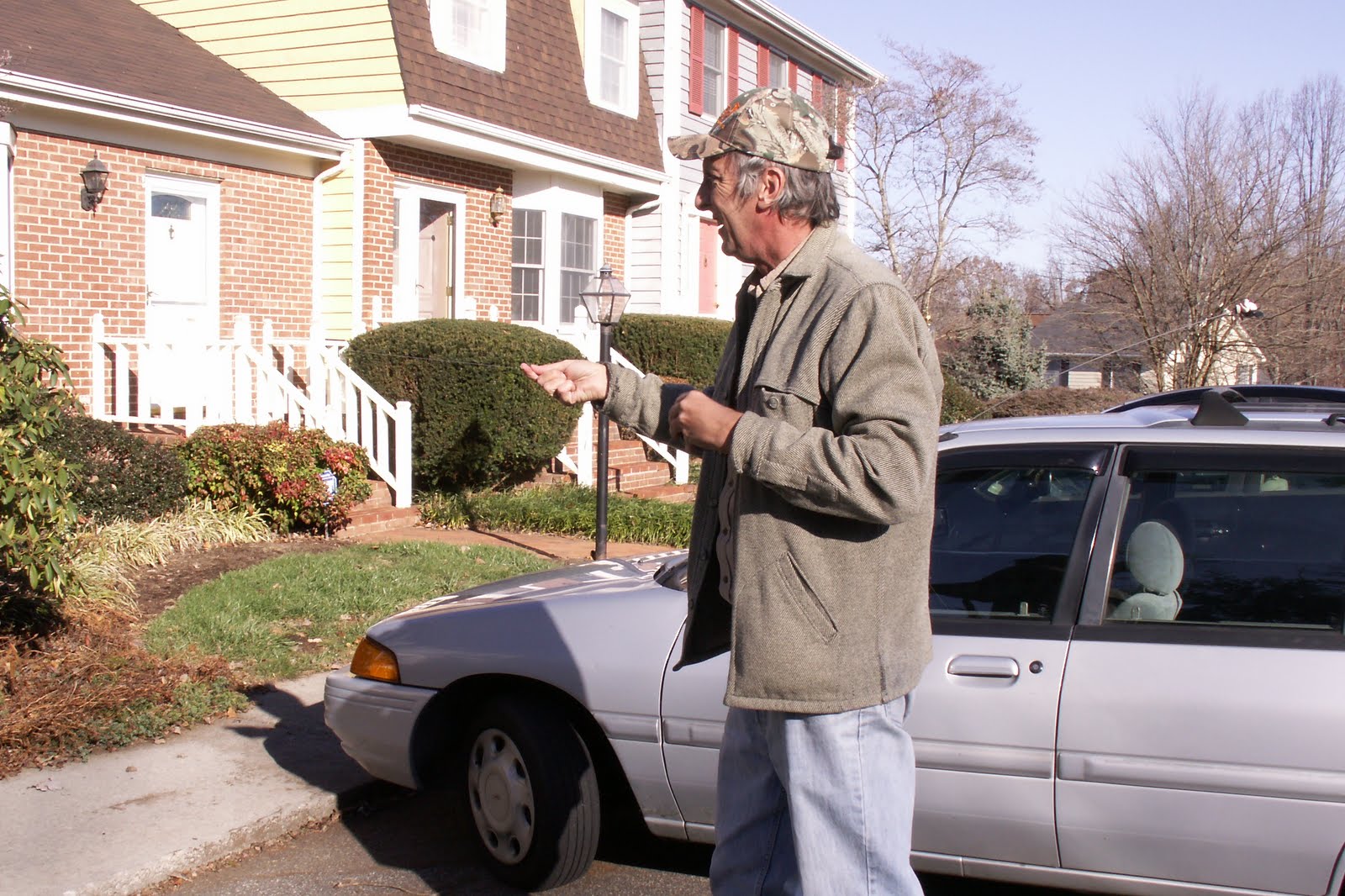
                                         Stan has traveled out to the western states many 
                                        times, and has seen these species of hummingbirds 
                                       several times before. I have seen a couple of Rufous 
                                       Hummingbirds over the years in Virginia, but never
                                       two in one day. That number in Virginia visiting at one
                                                   feeder was really close to a miracle, 
                                                     at least it seemed that way to me.


                                      Earlier that morning, Bruce Peterjohn 
                                        had already banded a hummer near Blacksburg. 
                                     That one turned out to be an adult Rufous Hummingbird. 
                                    He also told us that there were two other unidentified
                                    hummers coming to feeders in Christiansburg, but he 
                                    didn’t have the address of the homeowners. Those 
                                     would remain mystery hummers, at least for that day.


                                            Bruce set up his hummingbird trap in only 
                                             a few moments. The effort to catch and 
                                          band the mystery hummingbirds became 
                                          a bit like a fishing expedition, with the nectar 
                                      in the hummingbird feeder functioning as bait. 
                                        The hummingbird feeder was placed inside  
                                        the trap and a door to the cage was open. 
                                      Bruce kept the trap door open by fishing line 
                                             that he held spooled out from a distance 
                                                         of 15 or so feet from the cage.


                                         In just a few short minutes, one of the hummers 
                                        flew into the cage. Bruce let the cage door close, 
                                       then expertly caught the little guy in his gloved hand. 


                                          He took the hummer over to the back of his 
                                          vehicle where he had all sort of equipment for 
                                                      measuring and banding it. 


                                     Before the trap had been set up, Bruce had shown 
                                    us the tiny numbered aluminum bands that he gently 
                                                 places on a tiny leg to identify the bird. 

                                        He had to prepare the bands by cutting them 
                                        from a printed aluminum sheet and crimping 
                                        them around a band holder. The bands must 
                                           be smooth and light-weight so that they do 
                                                       not restrict the bird's movement. 


                                       While the banding was proceeding, I held the spool 
                                        of fishing line to keep the cage door open in case 
                                          the other hummer came in to visit the feeder in 
                                          the cage. I was never any good at fishing, so 
                                         during the time I kept the cage door open and 
                                              ready, the little hummer never appeared. 


                                           After the hummer was recorded and banded, 
                                            Bruce delicately placed the little creature on 
                                                  Melanie's hand for her to release it. 
                                                   With probable relief, it flew away. 


                                          Of course shortly after Bruce had banded and 
                                        released the hatch-year male, and had taken the 
                                        fishing line from me, hummer number two flew into
                                              the cage. He deftly caught this little one, too. 
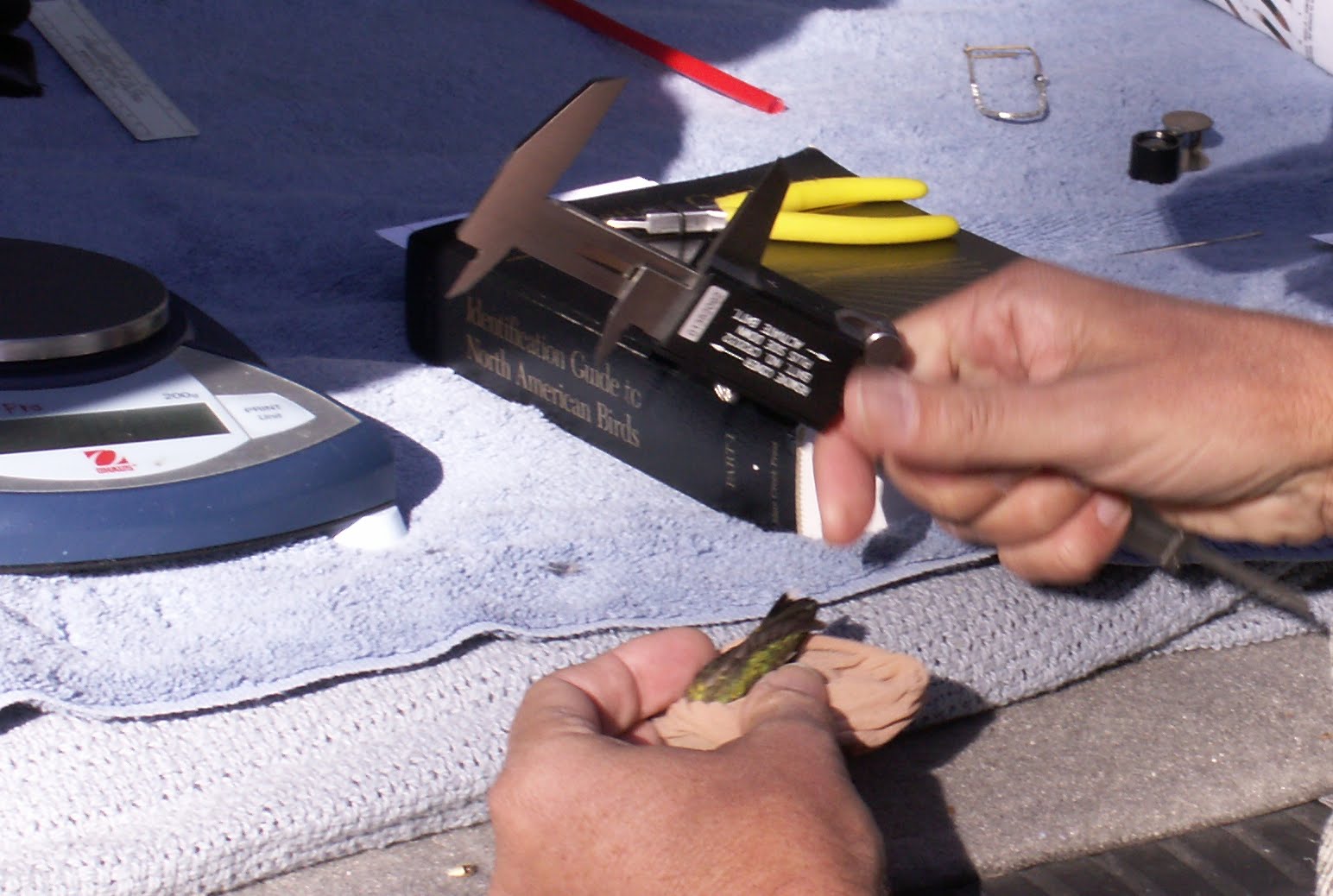


                                       Bruce weighed the tiny creature - about 3 grams, 
                                  I think. (An average paperclip weighs about 1 gram!) 
                                       He measured the length of its feathers and recorded 
                                    the information with the band number.The 2nd hummer
                                                  turned out to be a hatch-year female.


                                   When Bruce left us, he was heading to Franklin County 
                                   to band yet another hummingbird. He was successful 
                                   in capturing and banding this one--it was a hatch-year 
                                  female. So that’s a tally of four Rufous Hummingbirds 
                                        (Selasphorus rufus) in Virginia one day.

                                   Some Rufous Hummingbird facts:
                                   The Rufous Hummingbird nests further north than any other 
                                   species of hummingbird (61° N).

                                    Breeding range is from Prince William Sound, 
                                         Alaska to northern California.

                                      It has a very short nesting season in Alaska
                                   -shorter than for any other species of hummingbird.

                                       There are more and more records of this species 
                                     wintering in the eastern US. Perhaps one reason for 
                                     the increase in sightings is the increase in the number 
                                        of hummingbird feeders. This fact alone likely 
                                     helps with their survival. Bruce told us that Rufous 
                                    Hummingbirds are able to endure several days and 
                                            nights in a row of sub-freezing weather.


                                       Bruce Peterjohn works at the USGS Patuxent Wildlife 
                                       Research Center in Laurel, Maryland. He is the Chief 
                                         of the USGS Bird Banding Laboratory (BBL). He 
                                         coordinates bird banding activities throughout the 
                                                  United States and also U.S. Territories.


                                        He also volunteers with the Hummer/Bird Study Group, 
                                         and bands hummingbirds in Maryland, Delaware, and 
                                        Virginia. HBSG has documented fourteen species of 
                                         hummingbirds in the eastern US.

                                         To learn more about HBSG, visit their website:

                                           And to find out more about the 
                                            USGS Bird Banding Lab, visit:

                                 Photos ©N. Kent unless otherwise noted


Sunday, December 2, 2012

What big eyes you have!

         When I walk down the bike path in Wildwood, I usually stop at the restroom to
          see whether there are any critters that have landed on the outside wall to rest.
          Sometimes I find an interesting spider, and the wall has spider webs that often
          catch leaves and other debris.
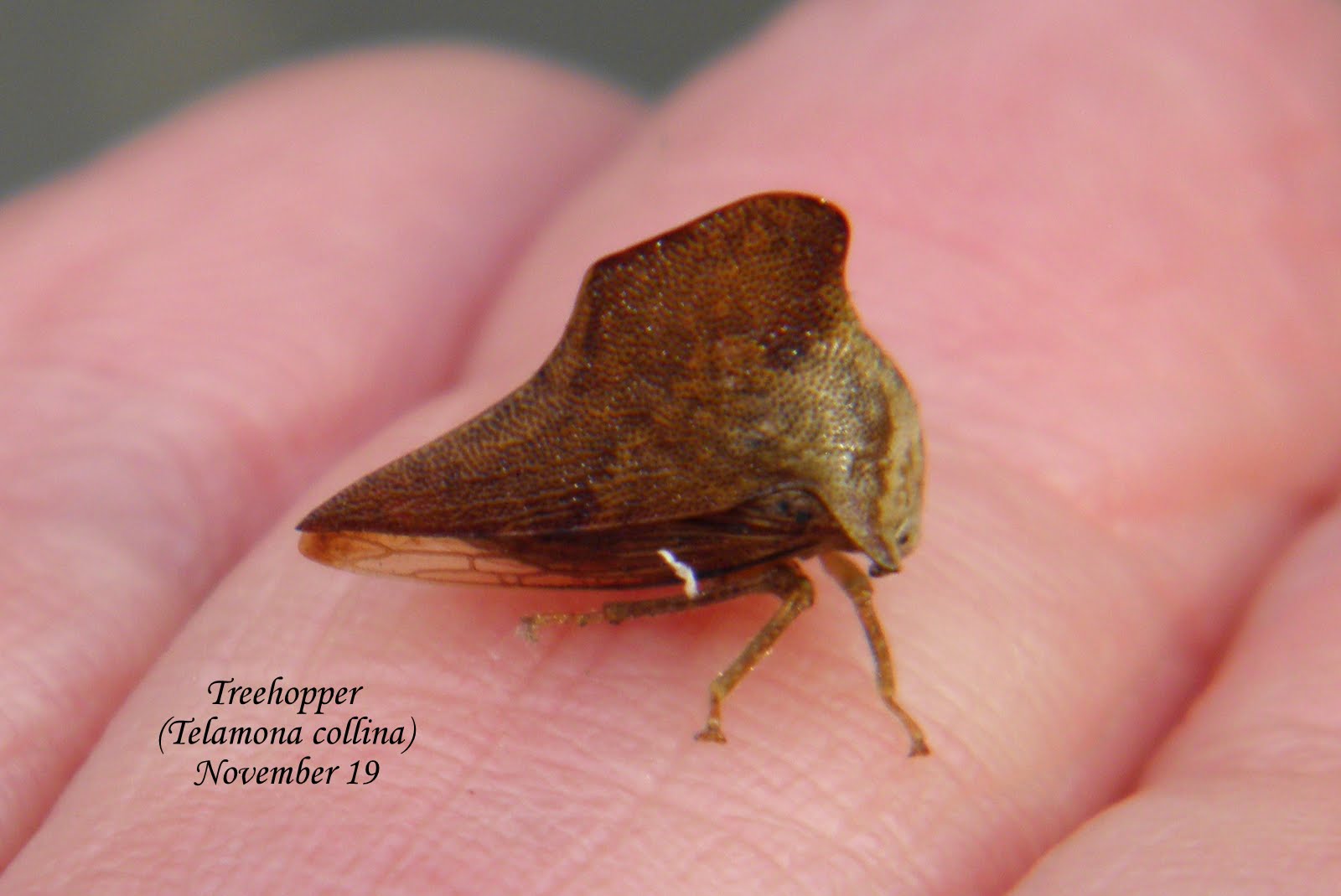
         One November afternoon, I thought I saw a small bit of brown leaf hanging in
         an upper corner. I gently poked it with a long stick. To my surprise, the dark
         "leaf" jumped away! I realized that it was some sort of bug so I snapped
          a picture and then tried picking up the critter. Another surprise - the
          critter seemed to like walking around on my hand!


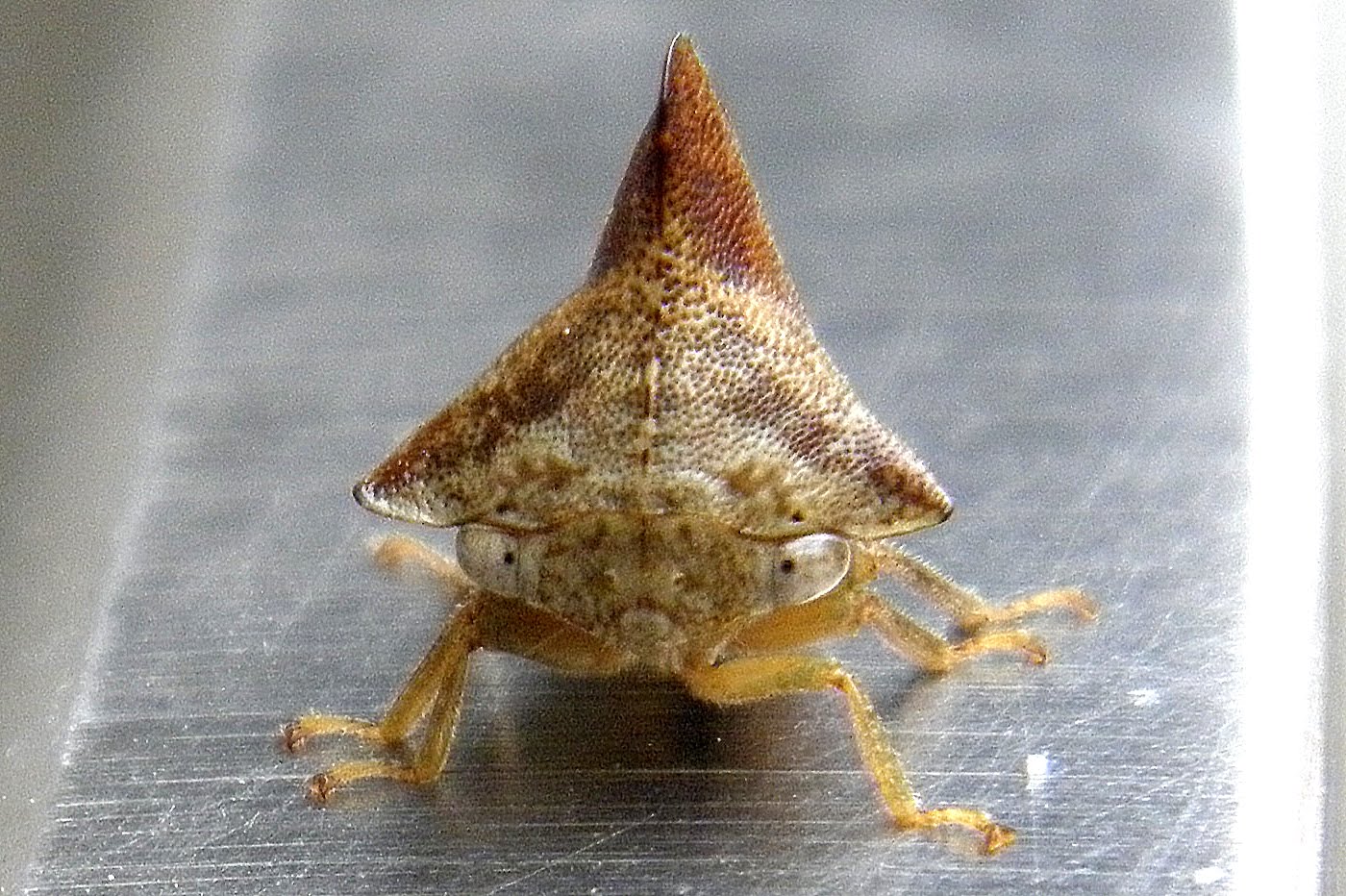
As I looked at it through my super macro lens, I could see that although its body was
dark brown, its "face" was a very light color and it had very big eyes!


           I use my macro lens instead of a hand lens to get a magnified view of of nature.
           This little critter had a very angular shape and looked very tiny in my hand.
           After I got home, I measured the width of my finger - it's about 2 centimeters
           wide. The little bug was about half that wide.


         As it crawled around and explored my hand, I got a good look at it from the
         side and could barely see its wings tucked along its side. I was glad that it had
         jumped from the stick to the ground and had not flown away. I sent a photo
         off to Bug Guide (a wonderful online website for critter identification) and
         found that it is a Treehopper (Telemona collina).

        After I took lots of pictures, I carefully, placed the hopper on the edge of the
        water fountain. I had a hard time convincing it to leave my warm hand on
        that cold day.
                                      
                                                I think it was really mad at me for that!


Monday, November 19, 2012

Another Rare Visitor

As I walked through the south meadow one sunny October afternoon, I noticed
that the air was filled with many white and yellow flutters - the Cabbage Whites
and Orange Sulphurs were enjoying asters and other flowers.
Although I didn't snap any photos of them because I already had 
many pictures of those common residents of Wildwood,
I loved watching them frolic in the warm sunshine.
The Cabbage Whites (Pieris rapae) have a wingspan of 32 - 48 millimeters.


Their caterpillars are a real garden nuisance because they like to eat cabbage!


Orange Sulphurs (Colias eurytheme) are about the same size as the Cabbage Whites. Their wingspan is 30-50 millimeters. I think that they look more yellow than orange when I see them flying.


However, I found one resting with its wings open on the pavement on Park Road earlier this summer 
and saw that it was indeed very orange looking.


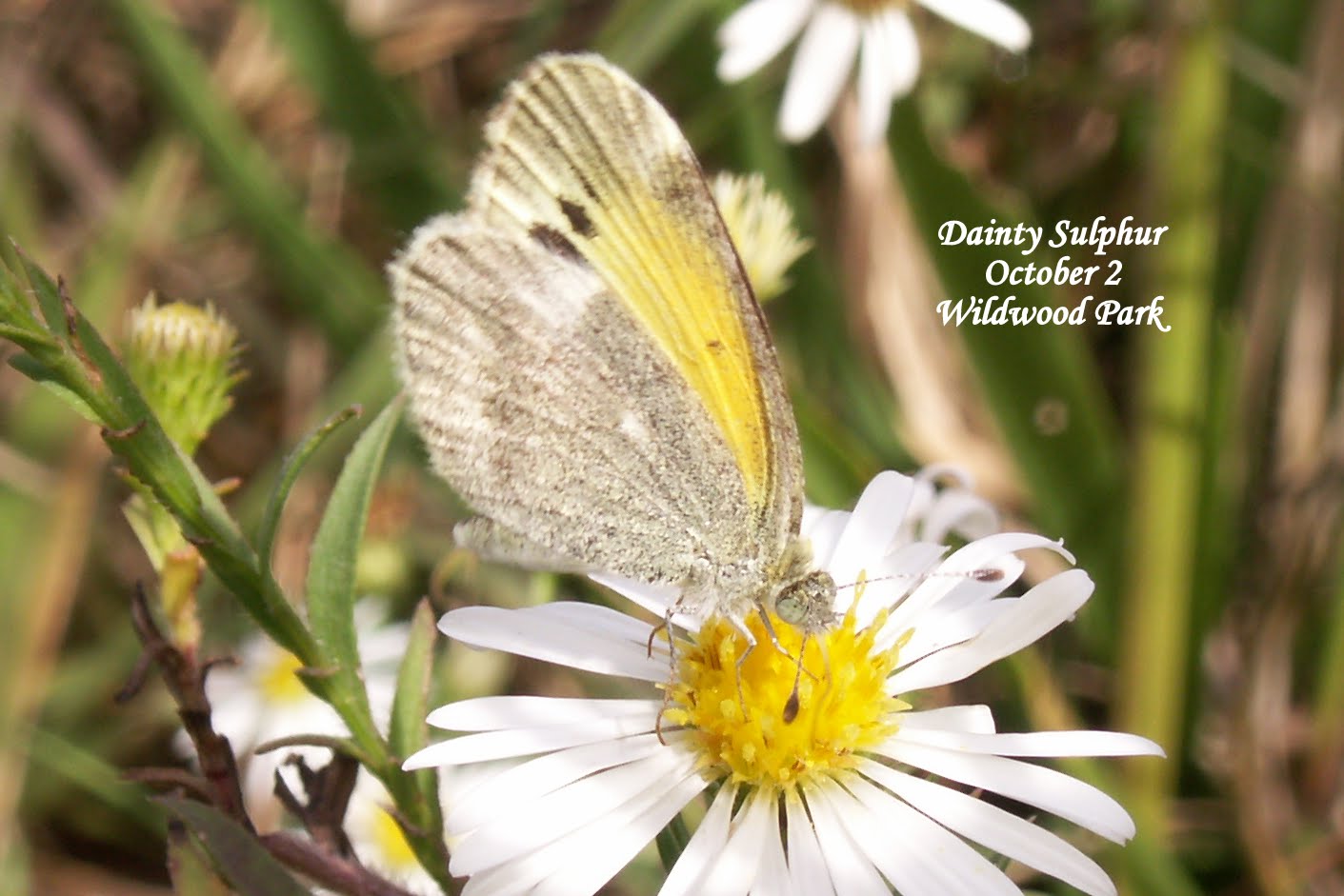
As I continued to watch the butterflies, I noticed that there was a much smaller
yellow one twirling around. It looked like a "baby" butterfly,
but I knew that those critters emerge from their chrysalises as fully grown adults.
As the tiny creature crossed the bike path, I opened my camera 
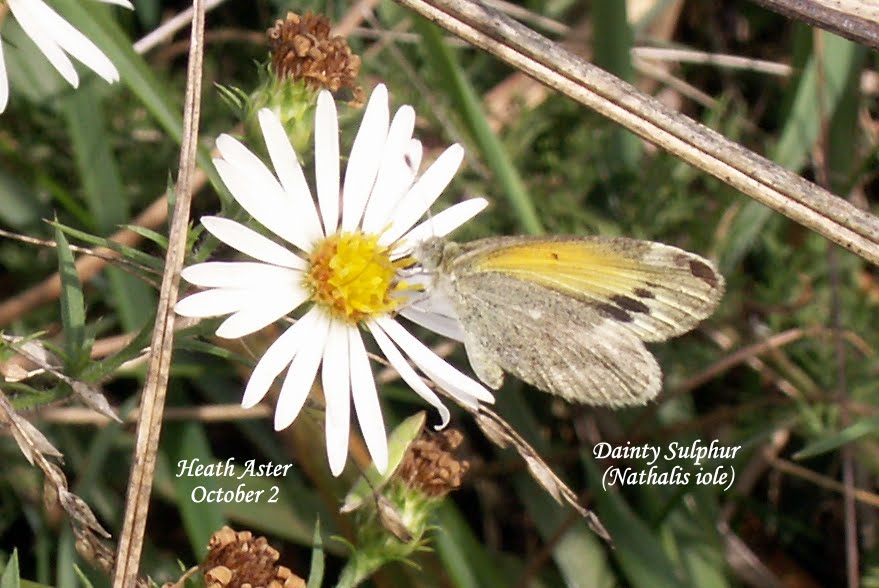
to be ready to get a shot. I was delighted to see that it paused on a small aster flower
long enough for me to to snap a couple of times.


I slowly inched a bit closer and snapped again. I could see that it looked similar to the Orange Sulphurs, 
but it had an elongated forewing that gave it a "stretched  out" look.


I managed to get a few more photos before it flew over the meadow and out of sight.


I later learned that it was a Dainty Sulphur (Nathalis iole) -
an appropriate name, I thought.
It is the smallest of all the Sulphurs and usually does not fly in our
valley and ridge area.
It has a wingspan of only 20-32 millimeters.
No wonder it looked so small as it flew with the larger species.

Once again I felt very fortunate to have my camera ready when a lovely visitor came to Wildwood!


Monday, November 5, 2012

A Rare Visitor

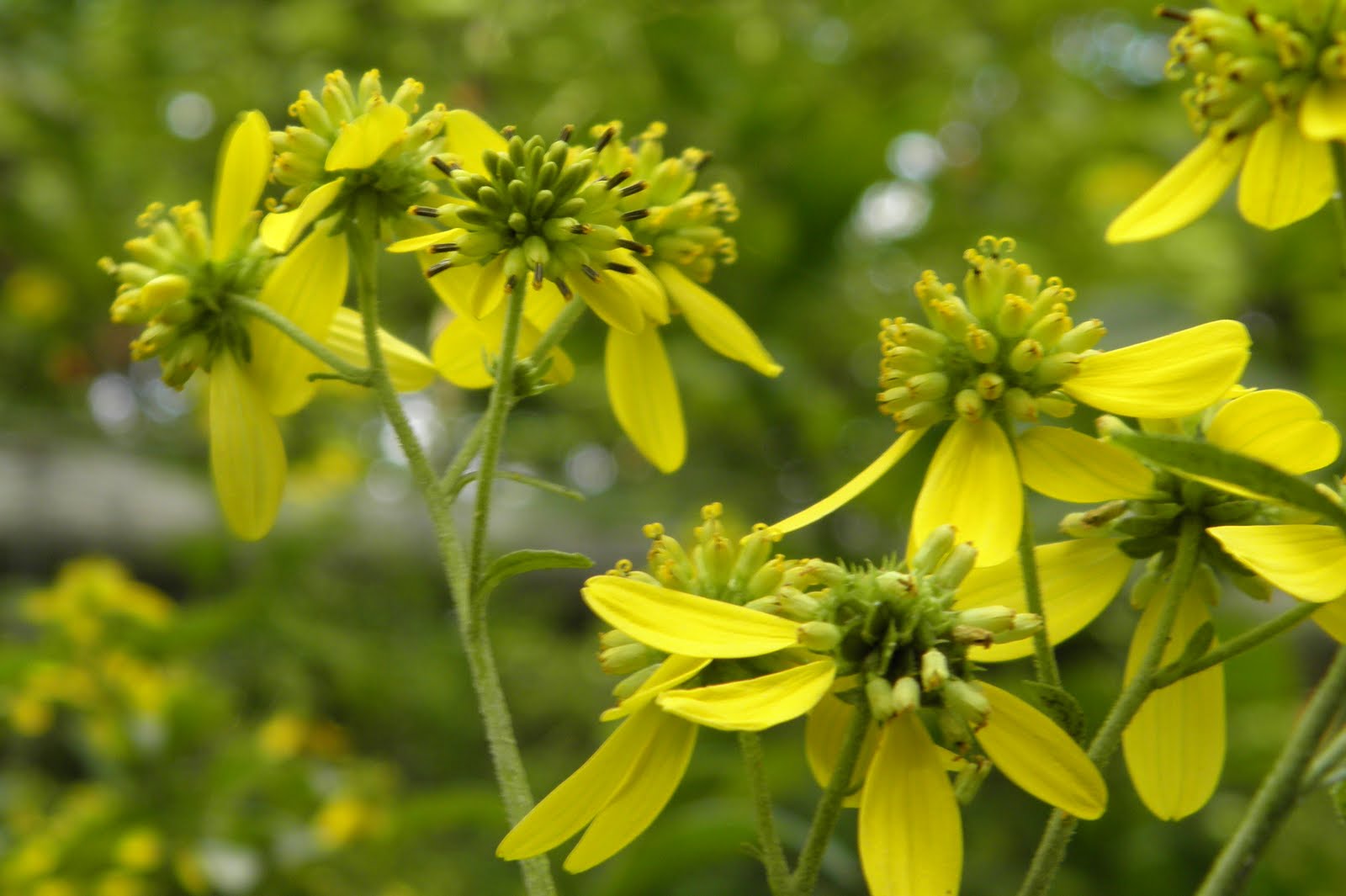
One spectacularly sunny September Saturday morning, I decided that I needed a few more photos of Wingstem flowers. I was not satisfied with ones that I had taken previously. I found just the perfect ones along the bike path near the entrance to the tunnel.


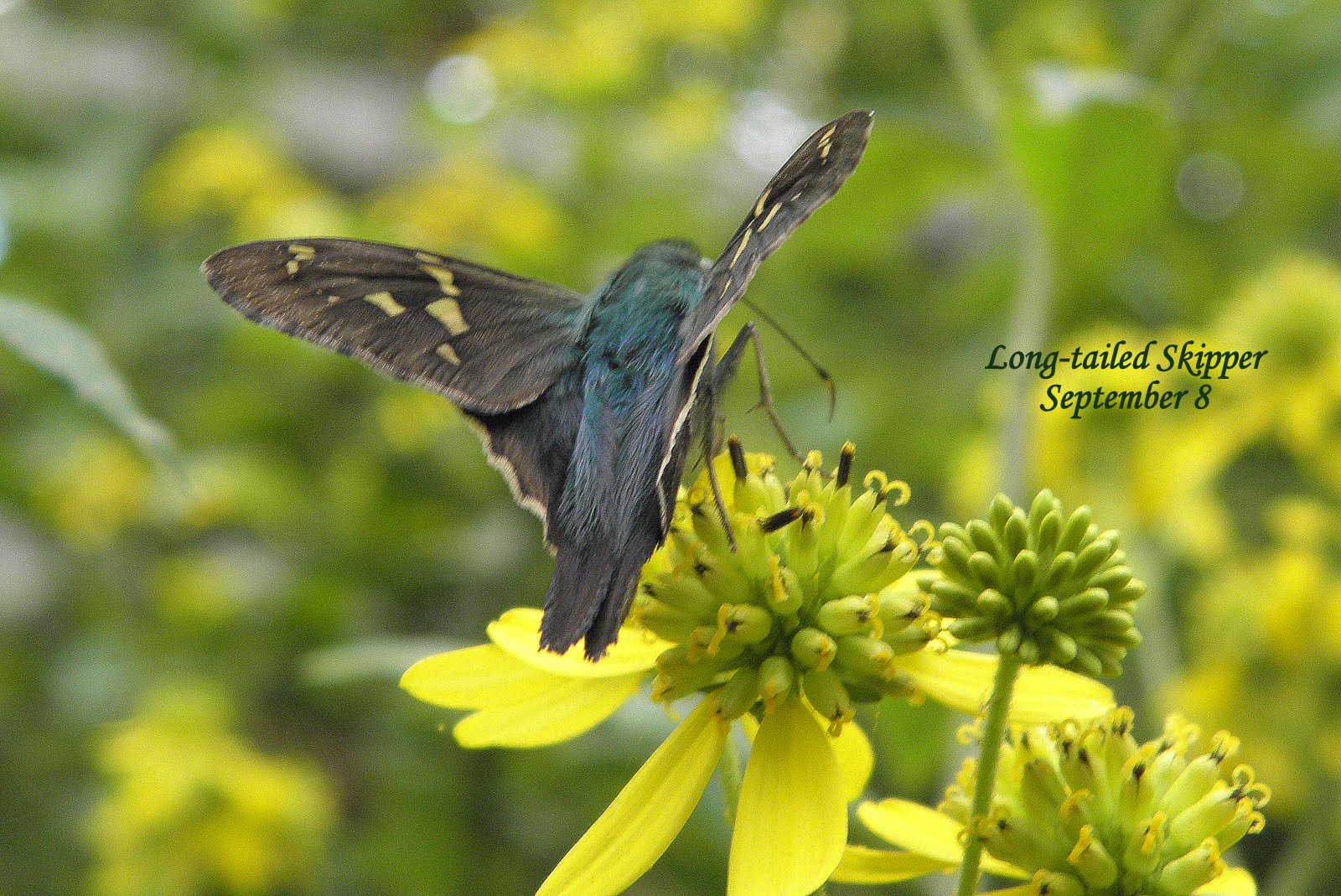
As I began snapping photos, I caught a glimpse of a butterfly flitting from flower to flower. From the corner of my eye, I could see small brown wings and a white spot. "Must be a Silver-spotted Skipper," I thought and continued focusing on the bright yellow flowers that would soon lose their petals as fruit formed. Well, maybe I should get one shot of the butterfly that seemed to like the flowers as much as I.


Wait a minute - those spots are on TOP of the wings! Silver-spotted Skippers have a single white spot on the underside! Forget the the flowers - focus on that critter!

In the bright sun, the small feathery-looking body had an iridescent blue-green sheen.


The underside of the hindwing had a continuous dark bar across it. And there was a LONG tail!!!
This was definitely not a butterfly that I had ever seen before.


It eagerly drank the Wingstem nectar through its long proboscis.


I eagerly took more photos as it lingered at each bloom.


When I got home I hurriedly uploaded the photos into my computer. Yes, I was certain that I had gotten pictures of  Urbanus proteus, a Long-tailed Skipper. I had images of the identifying features. I also discovered that I had not seen this species before because it is usually found in North and South Carolina and in the coastal region of Virginia. It has been rather abundant this year and has extended it range northward so maybe that's why one strayed into the hills of the New River Valley. 
It was such a sweet little visitor, I very much hoped that I would see another one in Wildwood some day.

And guess what?
 I did - just about three weeks later!!!


I feel very fortunate to have photo records of  two visits to Radford and Wildwood Park from this lovely creature. Perhaps the species will soon expand it range to include our area.


Friday, September 28, 2012

The tree that almost hit the bridge...

        Nancy's Note: If you haven't read the previous post written on September 27, please scroll back and read it before you read this one.
                                        

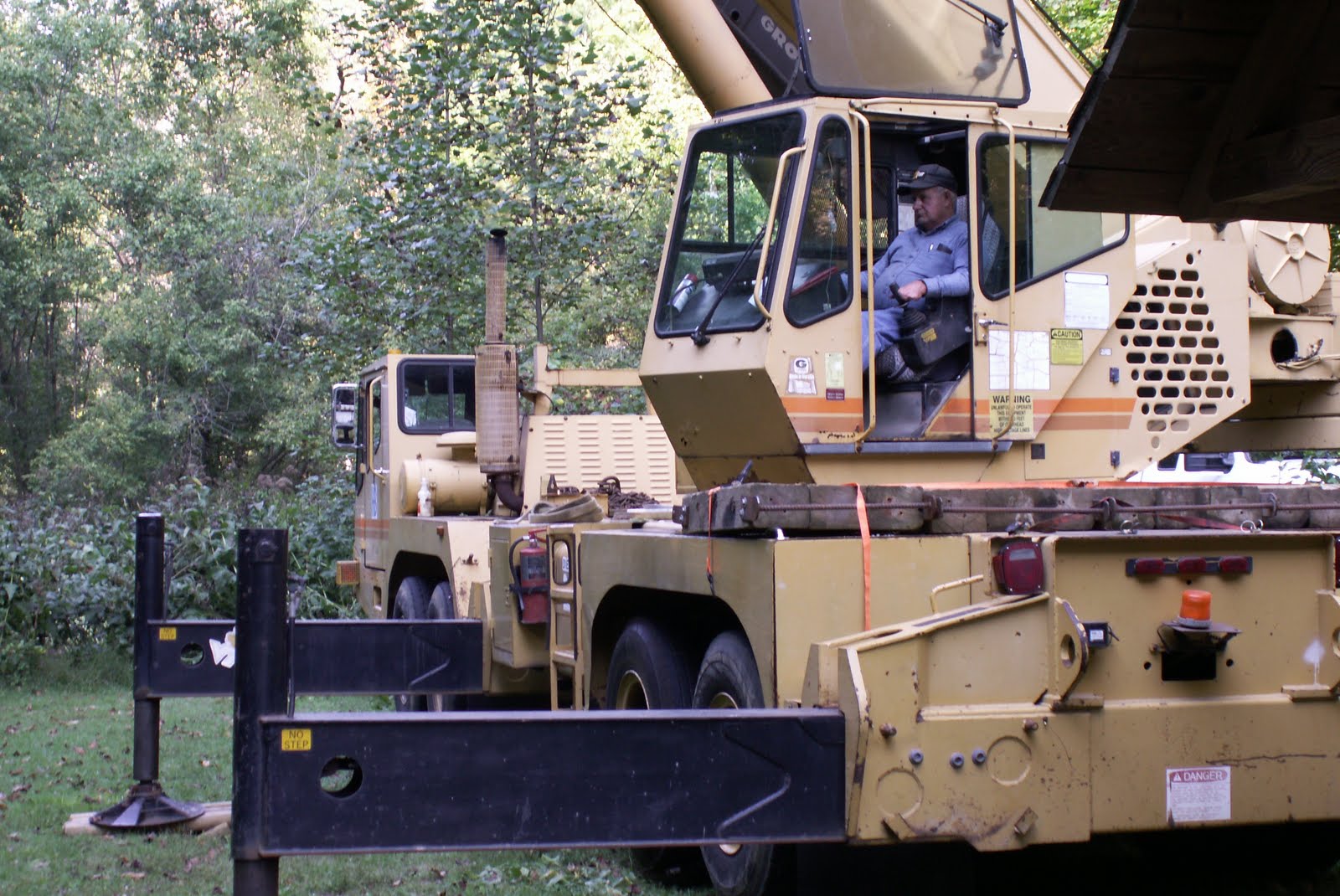
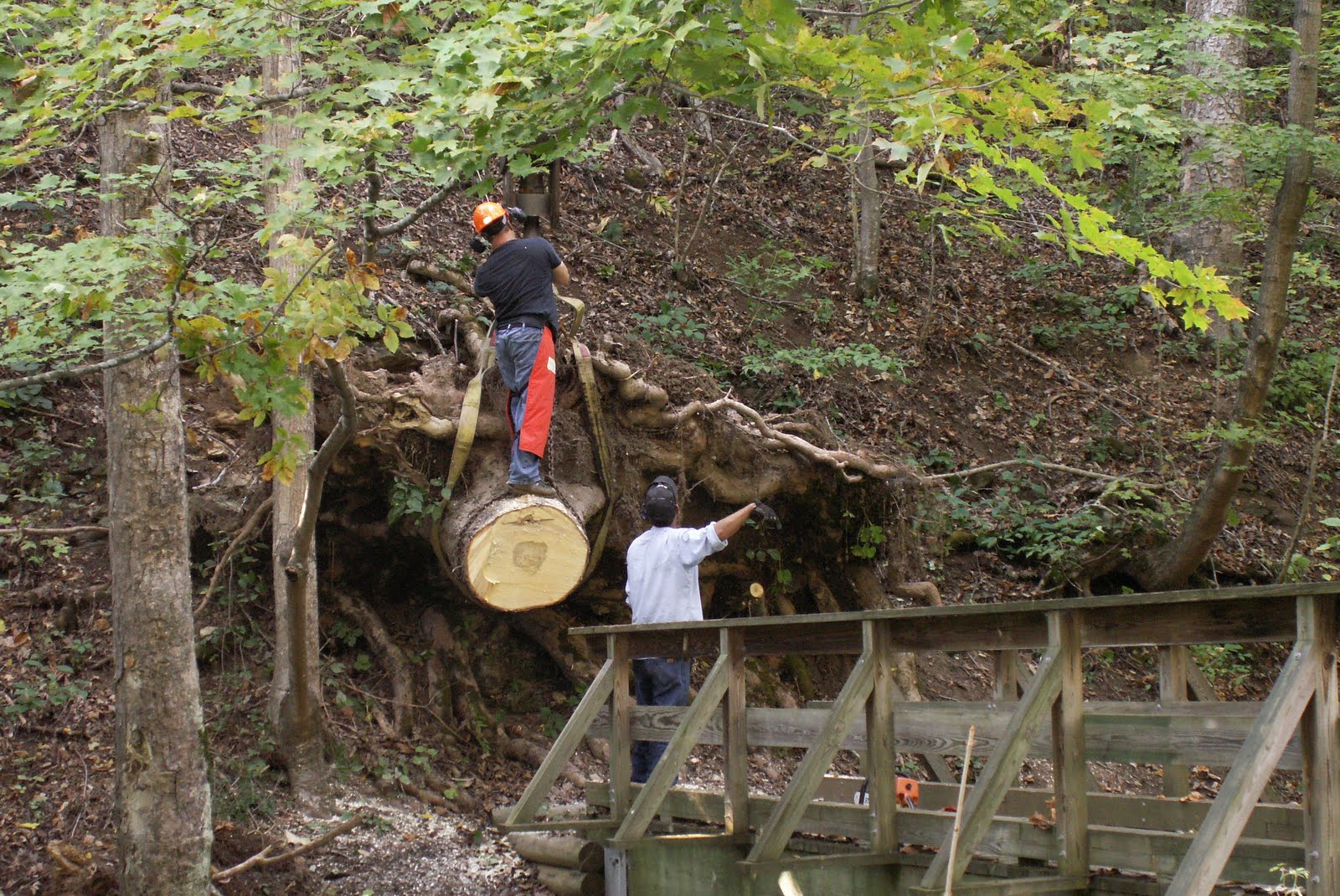
As I walked into Wildwood on Wednesday afternoon, September 26, I began hearing the noise of a chainsaw. "I wonder what's up - or maybe down," I thought as I hurried a bit faster. When I got almost to the Outdoor Classroom shelter, I saw a huge crane, and it was lifting a very big tree trunk. The tree that almost hit the middle footbridge during the June wind storm had been cut and was being lifted out! I had arrived just in time to get photos of the action. My adrenalin flowed into high gear.


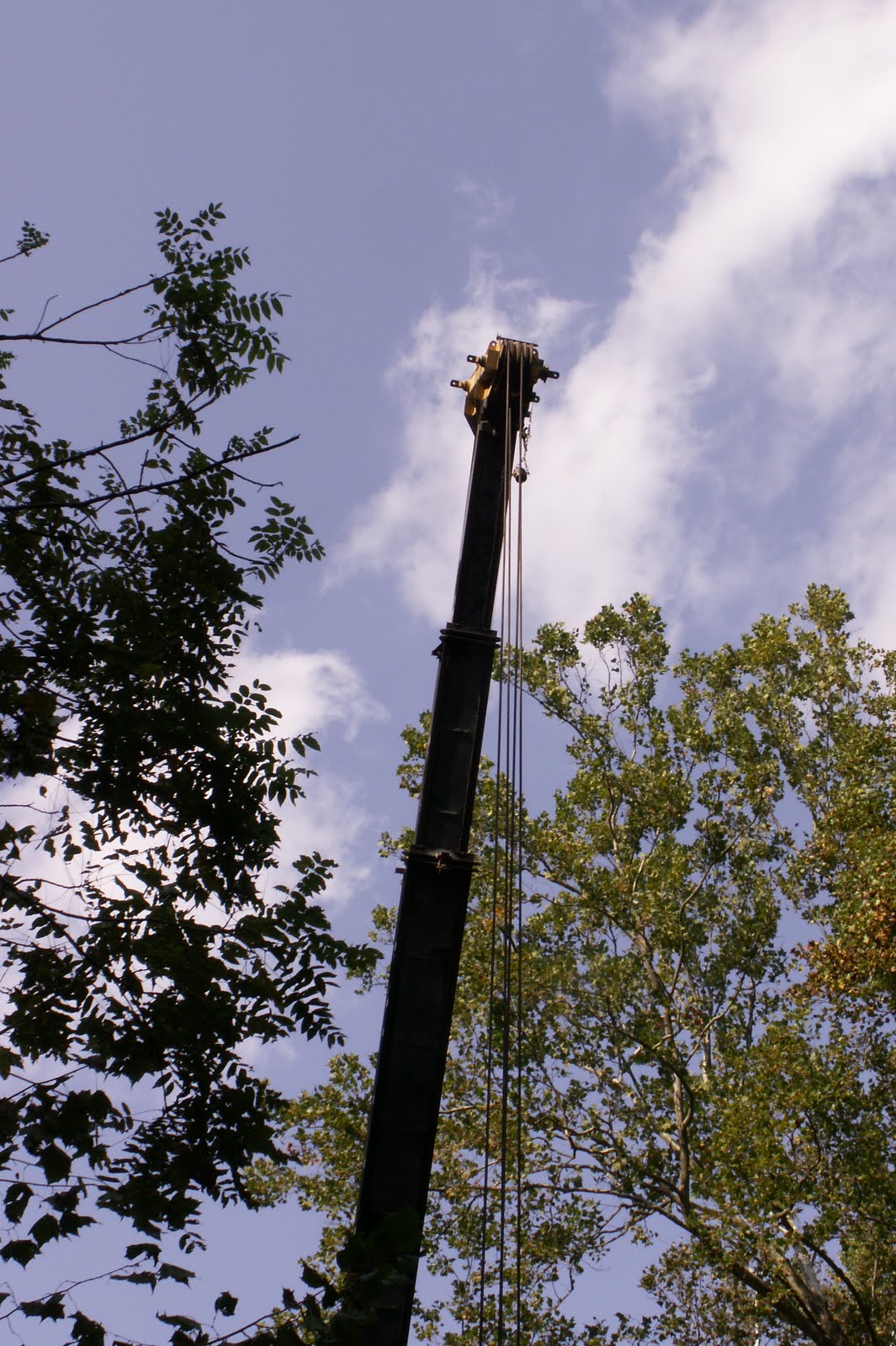
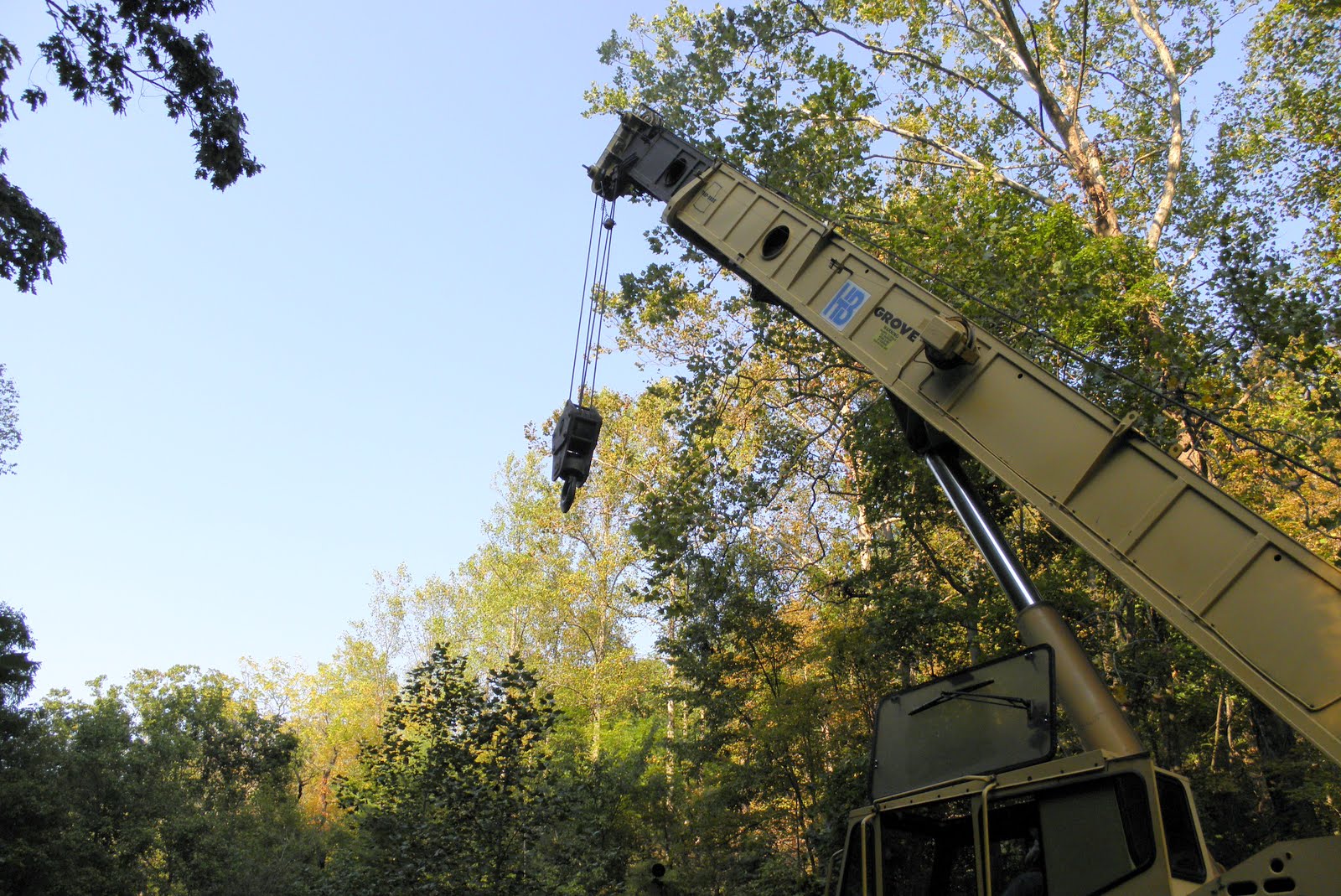
The kiosk (message board) was blocking my view, and I couldn't see the crane cab. However, I had no problem seeing the crane extended high above the tree tops as it seemed to brush the blue of the sky.


As I hurried on down toward the bridge, I stopped to ask one of the workers whether I could take pictures of the rest of the work. He said that I could and that it would be safe for me to stand on the bridge. Oh, boy - a front row position! From the bridge, I had a closeup view of Mr. H.T. Bowling who was operating the crane from his seat high in the cab.


From the bridge, I could see how big the crane really was. It had extended supports (out-riggers according to my husband) to keep it from toppling over  as heavy weights were lifted and shifted. And it even had a sunroof!


The remaining stump of the tree had been wrapped and secured with wide fabric straps like the ones used on the trunk. Two of Mr. Bowling's workers were on the bridge to talk with the guy (who worked with Mr. Dundas) in charge of the chainsaw and to give hand signals for the crane operator. Each move and cut would have to be carefully thought out.


Mr. Charlie Dundas was on the west slope to guide operations with his view from behind the stump. His bright yellow hardhat and shirt made it easy to keep him in sight!


                                Cuts were made through roots that were holding the tree in place.


                                                             More roots were sawed.


       Then the crane would try a lift and workers could see where more cuts needed to made.


And more cuts...


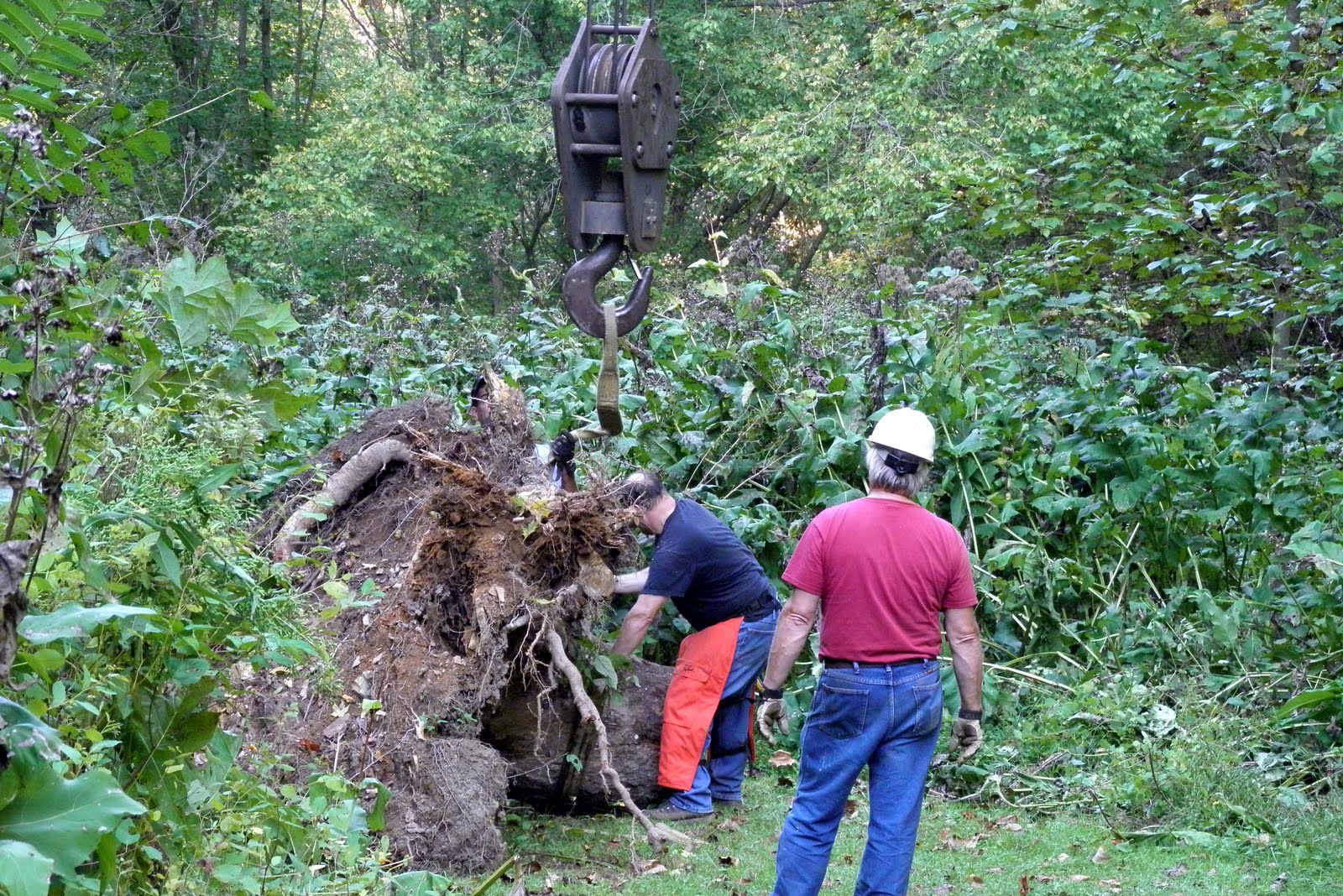
After much thought, cutting, more thought and cutting, and hand signals to the crane, the stump was finally free of all the roots that had held it in the ground. It was slowly lifted up and over the the bridge...


...and creek...


                                              ...and placed finally on the meadow creek bank.


With a wave from the cab, Mr Bowling announced that job was complete and that the stump had weighed 5,000 lbs. Wow!


            The crane boom was retracted to tuck back in place over the back of the vehicle.


The bindings were removed from the stump, rolled, and stored in their compartments. The outriggers were retracted and parts of those were put in their places. It was sort of like watching big boys put away their big toys except that this was serious business.


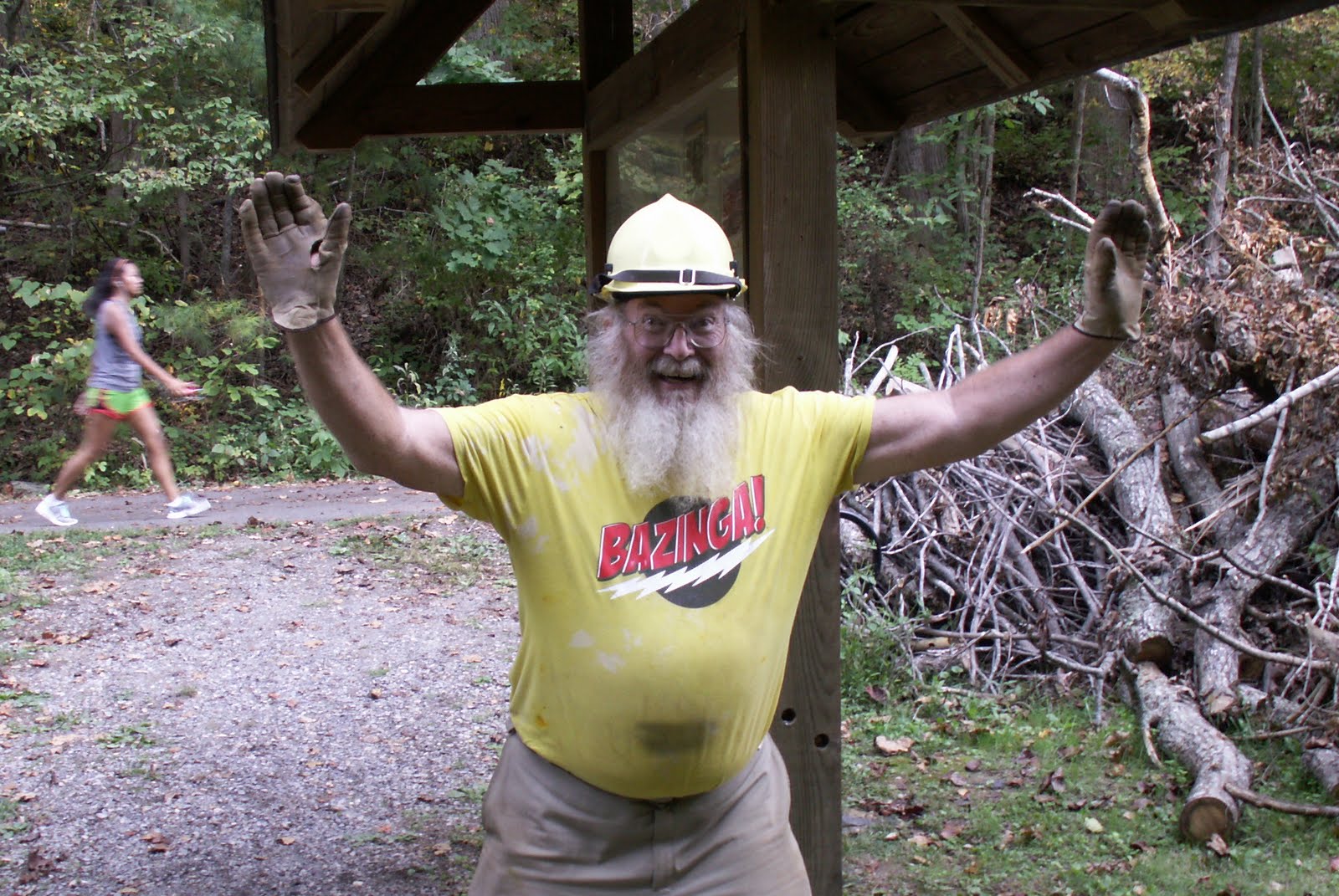
Charlie Dundas hiked down from the slope, smiling over a job well done. I finally could read his shirt's message and held my camera to record it. With a big smiled he boomed, "Bazinga!!!"


Seriously, I had an opportunity to see first-hand how co-operation and respect for each other's work have allowed Mr. Dundas and Mr. Bowling to accomplish difficult tasks together. Those are lessons that all of us strive to learn.