Wednesday, June 22, 2011

Welcome Back!

After traveling home yesterday from a short vacation in Richmond , I was eager to to get out to Wildwood with my camera. Actually, I'm usually eager to get out to Wildwood even when I've been at home! 
I began my walk in the Park at the Eighth Avenue entrance. The cell tower is up there and it's easy to make a quick check of what's happening in that open area. 
I soon began snapping photos of flowers and butterflies and bugs. One little brown butterfly gently fluttered by, stopped to rest in the grass, and allowed me to get close enough to take several shots. I did not recognize the species, and I wanted to get home to get a closer look at its image in my computer.
After dinner, I began my search. I soon realized that I had found an extremely rare critter that had made its home in Wildwood for at least eighteen years according to Clyde Kessler, who also confirmed my identification. These insects are also extremely local within their range. He had told me to be on the lookout for them, but we had not seen any at all last summer. We feared that aggressive spraying under the power lines might have harmed the insect or its habitat.What a joy to discover that our friends had only taken a year's vacation. Even a Northern Metalmark (Calephelis borealis) knows that Wildwood is a wonderful place!


The Northern Metalmark likes limestone and dolomite so the Elbrook Formation of Wildwood is a perfect place for the lovely creature's habitat. It loves to nectar on Butterflyweed but will be satisfied with Rosinweed, Oxeye Daisy, Mountain Mints, and such. For laying eggs and feeding larvae they need Ragworts (Packera) - particularly Round-leaf Ragwort (P. obovata) and Prairie Ragwort (P. plattensis). 
These plants grow in the Wildwood. 
Take a close look at the photo above. Can you see how the Metalmark got its name? Clyde says that when the sunlight catches their wings just right, the markings look to him like embossed silver threaded into the wings. They almost always land and perch with their wings open and flat so that getting a photo or even a look at their underwing is not easy. The mostly dark pattern allows them to be camouflaged and hidden from predators. They are reasonably calm when perched, so I was able to get my camera close and on the ground when one was perched on a low limestone rock and got the photos below of the light colored underwing as it slowly lifted itself on its four long back legs. Notice the two very short front legs - this is a characteristic of the male of this species. Females have two long front legs as well as four long back legs.


Now you can get a glimpse of the metal marks that give the butterfly its name. How about those compound eyes! Many insects use those as an excuse to dart away when a human puts a camera in their face. Love that calm...I snapped several shots and then wished that the critter would fold its wings up. It did raise them a bit, enough for me to feel successful with getting several views.


Metalmarks enjoy open glades, road cuts, power line cuts (without spray!), all with limestone soils. In most areas there is only one brood flying from mid June to mid July.
We must take care to guard the habitat of these small jewels and do all that is possible to ensure that they always find a comfortable and inviting home in Radford.
Welcome back to Wildwood, gentle friends!


Monday, May 30, 2011

...passing through...

Many people and animals pass through Wildwood Park on their way to another destination. On May 20, I was substitute teaching at Belle Heth Elementary School and had the pleasure of accompanying three third grade classes to Bisset Park so that they could meet their pen pals from Riverlawn Elementary School and get acquainted over a picnic lunch. Mrs. Woolwine knew that I would enjoy the day as much as her students. 
A police escort cleared the short stretch of Second Avenue and Park Road and met us at the school. Students were eager to have the opportunity to walk with me through the Park and see places that I had shown them in photographs.


Walking through the tunnel was quite a noisy time - imagine 60 nine-year-olds trying to out-scream each other. We arrived at Bisset  in time to play a while before our Pulaski County friends got there, but soon students were busy meeting each other, asking lots of questions as they ate lunch together.

Our police escort was called to see us safely out of the park and back up the hill to school. Their small electric car was even able to drive down the bike path to see where we were so that other police officers and regular cars would be ready to guard intersections for us. We declared the day a fun and successful outing!


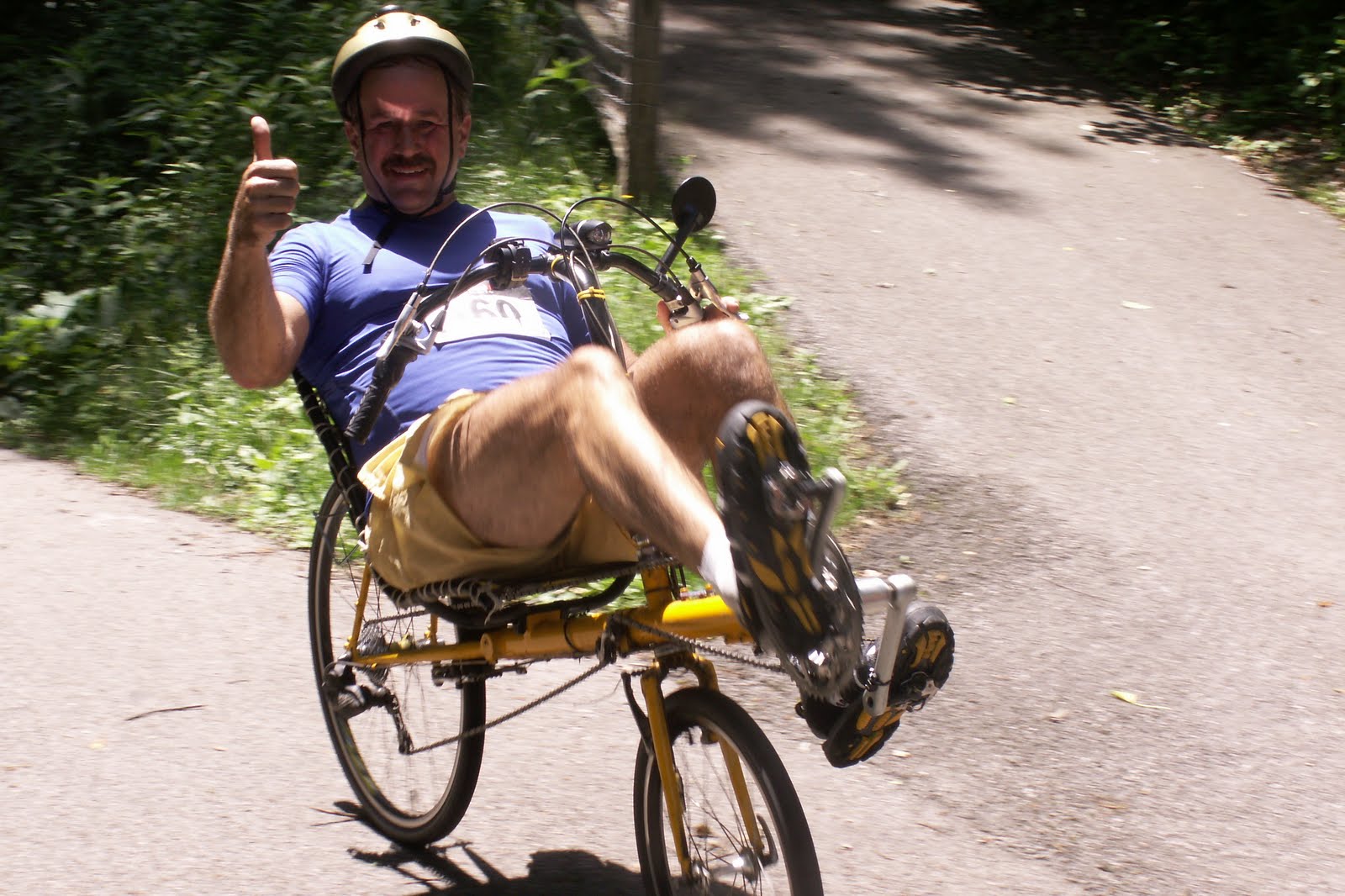
On Saturday, May 28, bike riders came through the Park as part of  the Wilderness Road Ride. Of course, I was there with my camera to see a few of the participants. Some whizzed by in a hurry. Perhaps riding in tandem allows you to ride faster?


                   Others were more leisurely. Can you guess what a recumbent bike is?


                    All of the bikers were glad to be coming to the end of their day's journey.


When I decided that I had taken enough pictures (Do I ever really take enough?!!) and needed to head home for lunch, I walked up to Main Street to take one more look down into the Park from above the tunnel. Imagine my surprise when I looked down the sidewalk and saw five horses coming along the walk with riders on two of them. Of course, I asked whether I could take photos, and the riders said, "Please do!" Chris and Shauna had begun traveling from Dallas, Texas, on March 8, 2011, and were on their way to New York City. They had decided to take the long journey to get attention for childhood cancer and hoped to raise $3,000.00 $1.00 for each mile of the round-trip) for Heroes for Children. They didn't actually pass through Wildwood but I thought that you would like to see them and  read about them.


NOTE: Be sure to take a look at the sidebar photos to see a few of the dogs that pass through the Park with their owners. Those dogs do their part to help keep their owners in shape!

Saturday, April 30, 2011

The Return of a Jewel

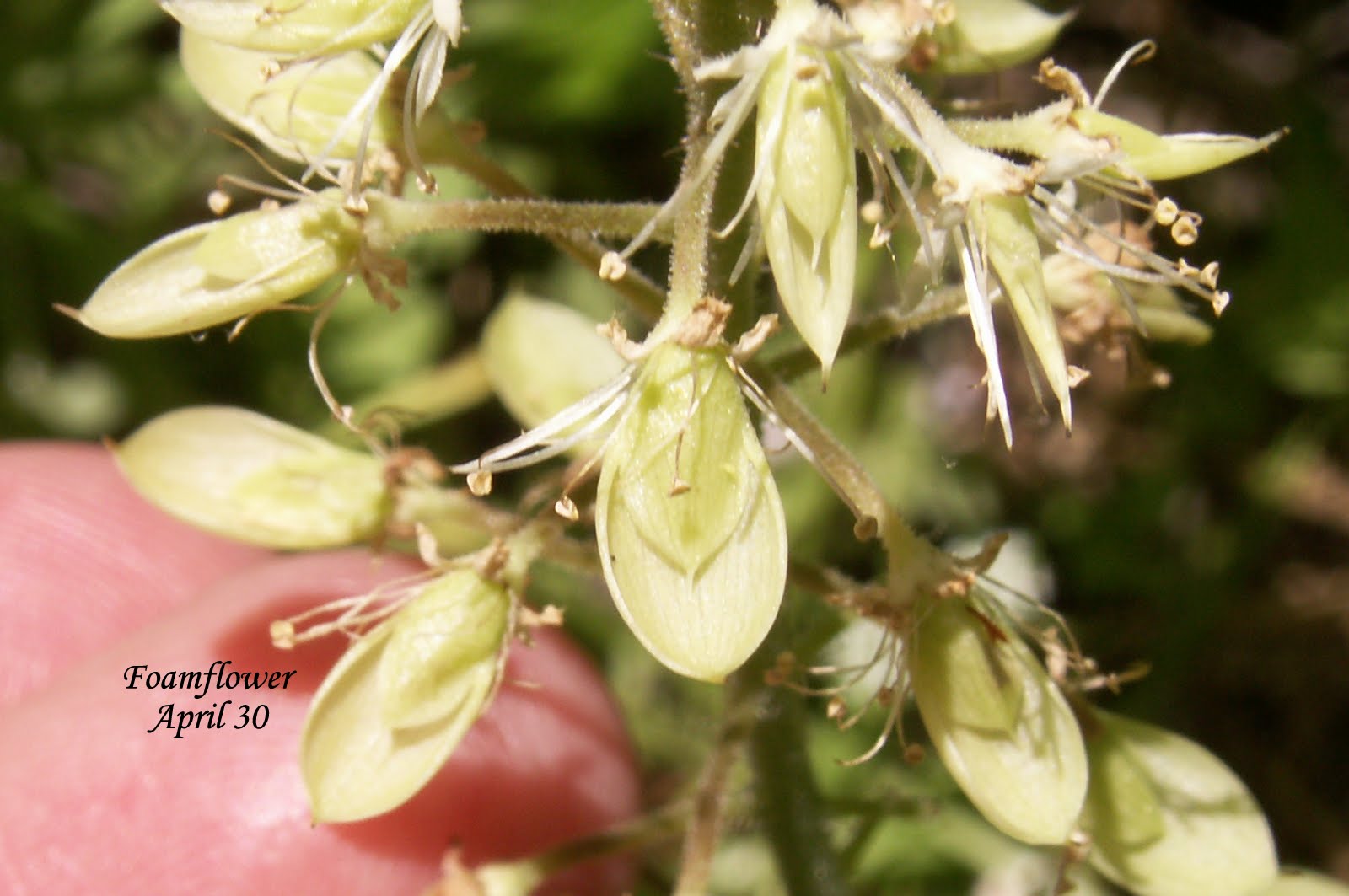
While walking in Wildwood recently, I saw my friend Clyde Kessler. As we wandered, talking and listening for birds, he showed me an area where he had found a couple of foamflower plants about ten years ago and asked me to help him hunt. He had not seen any signs of the plants for three or four years. Well, I didn't know what they looked like, so I wasn't much help and we soon gave up. The following Saturday, I received an email from him saying that he had found the white flowers in full bloom. I grabbed my camera and headed out!


I could see that I was in for a treat - there were about a dozen plants (a welcome increase from the couple of ten years ago!) with white flowers spikes rising above the floor of green. I began snapping lots of photos and getting a closer look.


The Latin name for the plant is Tiarella cordifolia. The word tiarella means little tiara or crown, and the blooms certainly rival any of the jewelry adorning the queens and princesses seen in the media at the royal wedding this weekend.


I can imagine that a fairy princess might choose one of these sparkling flowers for a crown. As with most wildflowers, foamflowers have a variety of common names: heartleaf foamflower (The leaves do not look heart-shaped to me!), false miterwort (The leaves of this plant look very much like miterwort leaves), sugar scoop (Clyde's favorite), coolwort, and Allegheny foamflower. Whatever the name, it is a lovely treasure and I feel very fortunate to have had my camera handy when I first saw its freshest flowers.


When I visited Wildwood today, I checked on the foamflowers. Many of them are bearing fruit now as the flowers drop off. Yes, Clyde, we can see where the sugar scoop name might have come from!

Monday, April 25, 2011

The Brown "Nut"

It was a cold and dreary day, but I was eager to get back to Wildwood after ten days in Wisconsin (where it was really cold!) visiting our grandchildren. After riding in our van for a day and a half, I needed to stretch my legs and breathe fresh air.
I began my short hike at the south end of the park and walked briskly along the bike path, soon reaching the wetland near the Main Street entrance. My camera had stayed snugly tucked in its case because a mist of rain had begun shortly after I arrived at Wildwood, and my hands were too cold to press buttons. At the water's edge, I saw a few large dandelions looking like sunbeams in the grass and plants. I also noticed a medium sized brown nut among the flowers. I knew that there were no nut trees in the area so I stooped down to get a closer look and saw a slug curled over an unopened bloom. Out came my camera - I couldn't leave Wildwood without a few photos!


The slug slowly stretched out, and I continued snapping. I watched it stretch out its tentacles to explore its surroundings.  


     The rain and mist left beads of water on the jewelweed seedlings that were also beginning to sprout.


As I reflect on that moment, I realize that unpleasant weather had drawn me to a lovely creature that I probably would have overlooked if other flowers and critters had been more abundant and I had been taking lots of pictures. And yes, I do think that the slug has a peculiar beauty of its own.   

Sunday, March 20, 2011

Going Batty!

I was enjoying a warm spring day in Wildwood last Saturday, walking along the bike path when I saw a bird flutter across in front of me. "That bird sure has a "fluttery" way of flying," I  thought. Then it landed on a tree trunk, and I saw that it was small and brown - "maybe a brown creeper," I thought.


The "bird" didn't move - seemed stuck to the tree, and suddenly I realized that it was a bat! I moved closer to the tree and began taking photos, getting a closer look at the tiny, furry creature. Its head stayed tucked into its feet as it clung to the bark. Its fur was shiny in the sunlight, and its ears were even shinier.


I sent the photo to Gary Cote, the webmaster for the Wildwood website and Biology professor at RU. He forwarded it on to Karen Francl, the bat expert at RU. She says that it is a Big Brown Bat (Eptesicus fuscus). She also said that the bat looked very healthy and that it isn't unusual for bats to go foraging for food on warm days although we usually consider them to be nocturnal animals. I guess they enjoy the warm spring weather as much as we do!


The bat had chosen a tree that was directly across from Adams Cave , which is probably is its home. The cave overlooks the south end of the park, and the creek runs below it, providing a source of water and insects for food for the flying mammals. A few days later, I again saw a bat flying near that same area. As it flew against the bright sky, I could see the outline of its bones through its wings and could also see the silhouette of its tiny ears and nose. A magnificent sight that I had never seen before - isn't Wildwood  wonderful!  


Friday, March 4, 2011

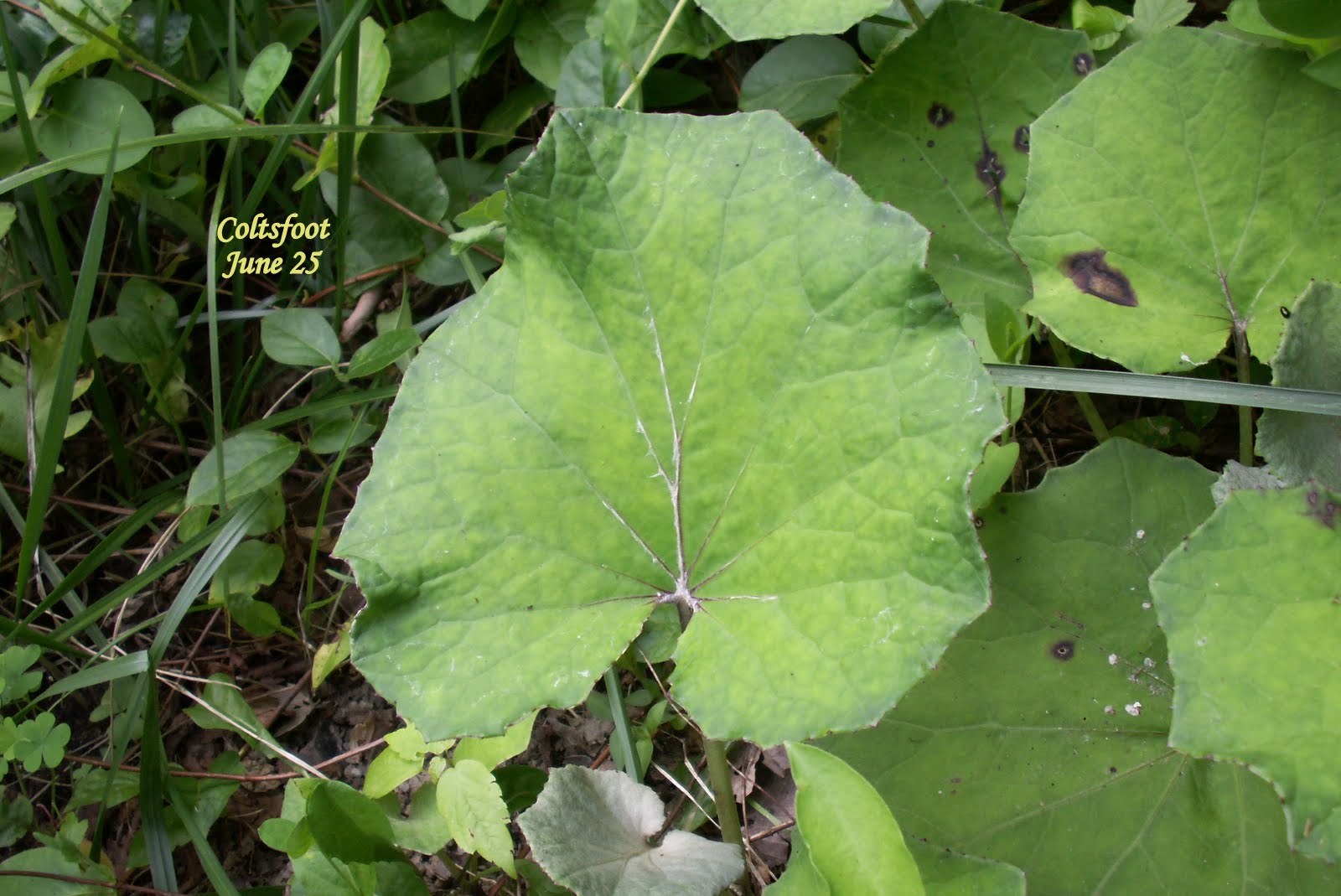
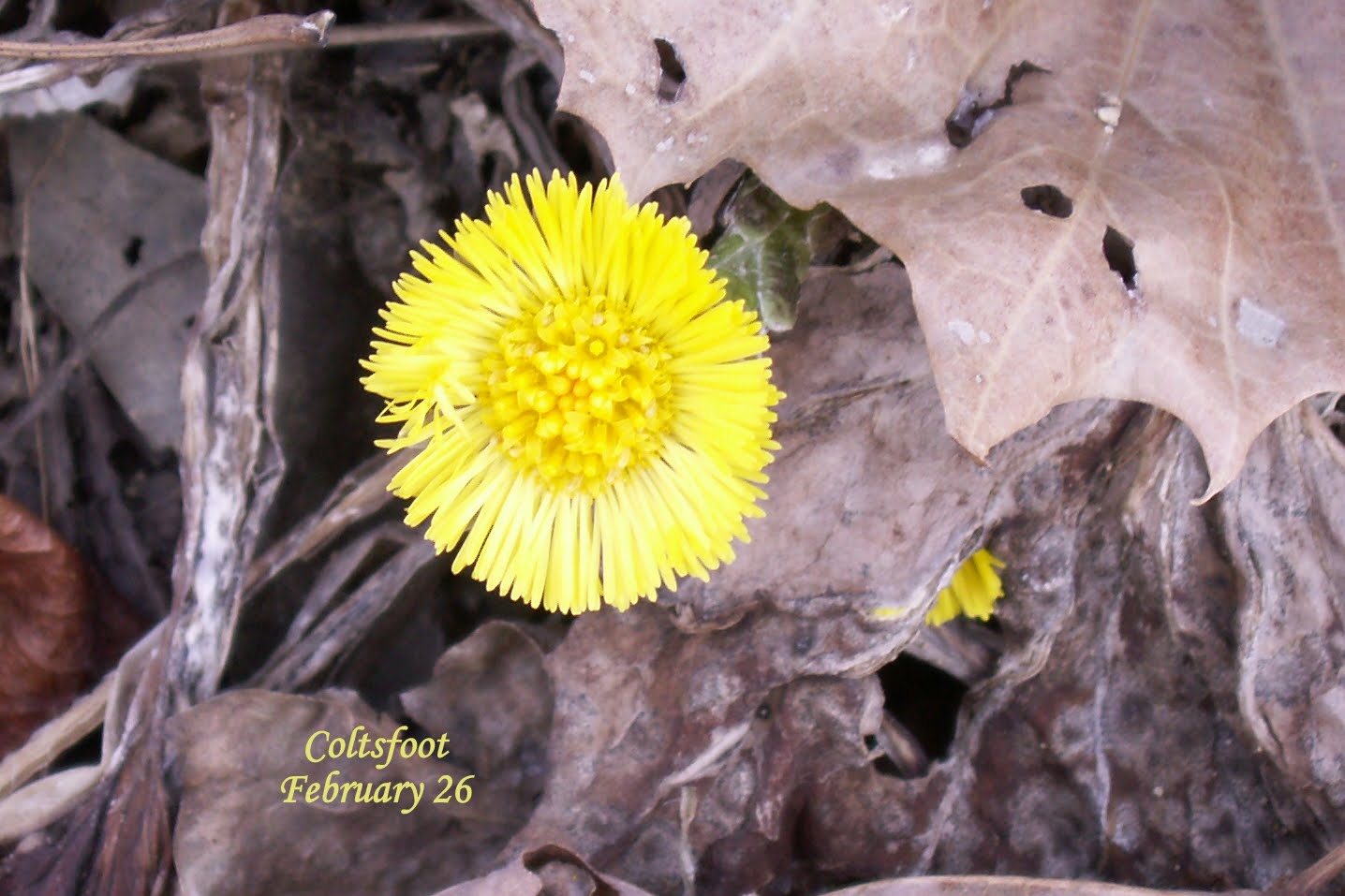
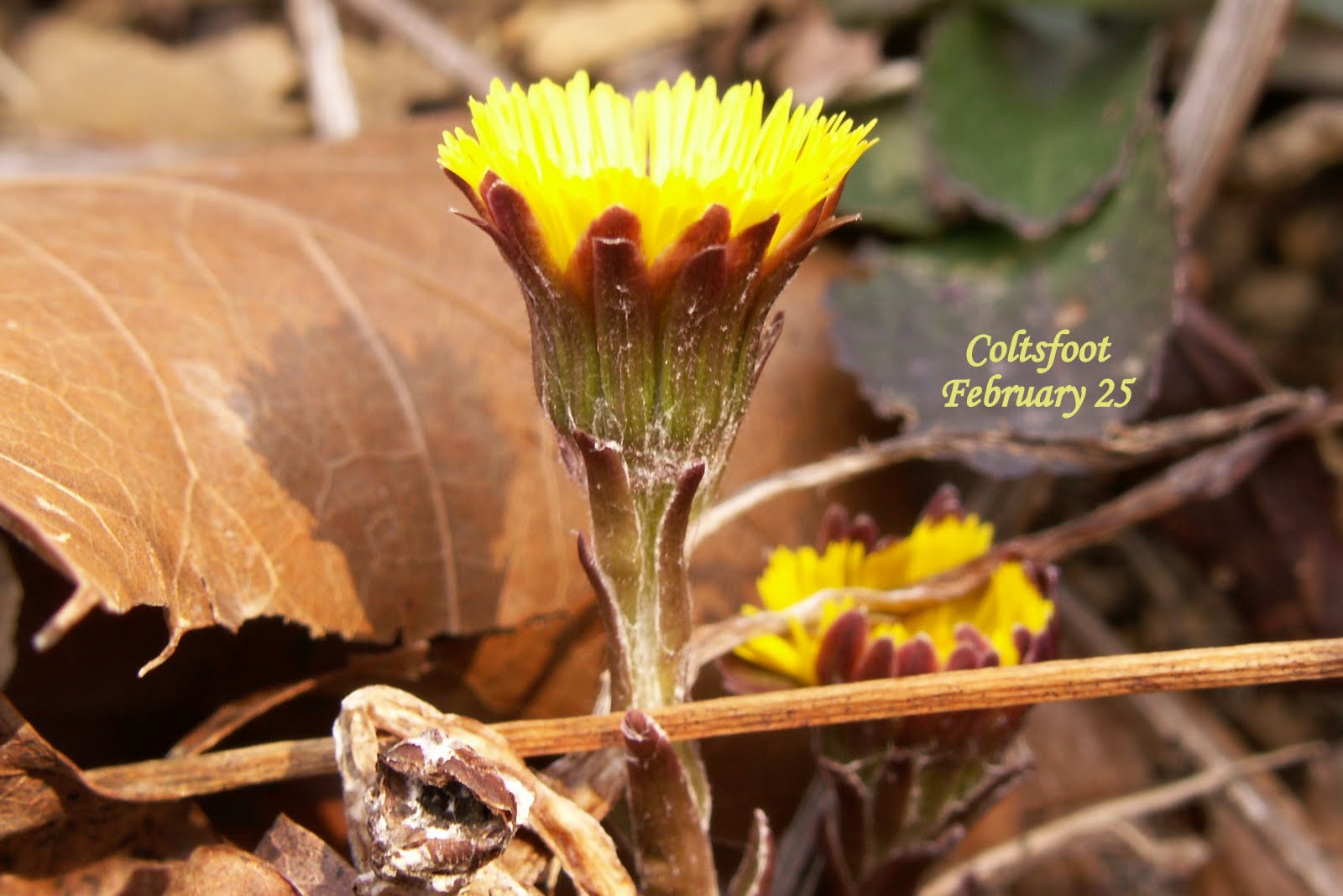
Coltsfoot (Tussilago farfara)

Coltsfoot - how's that for a wildflower's name!
The name is actually a description of its leaf 
which does not appear until after the flower blooms.
Do you see how the leaf is shaped like the hoof of a small horse or colt?


Coltsfoot is blooming now in Wildwood and is bright enough and large
enough to be easily seen.
Do you see a flower that is trying to hide behind a leaf in the photo below?


You might mistake coltsfoot for dandelion which will be blooming later.
However, if you carefully take a look at the backside of coltsfoot, you will see that it
is a reddish color and not at all like a dandelion.


Colstfoot will try to fool you again when its seed puffs form in April.
It tries to look like dandelion again. How do you think the seeds might spread?


Look for coltsfoot the next time you walk though Wildwood.


 SEVERAL NEW POSTS HAVE BEEN MADE IN MARCH.
BE SURE TO SCROLL DOWN TO VIEW THEM ALL!

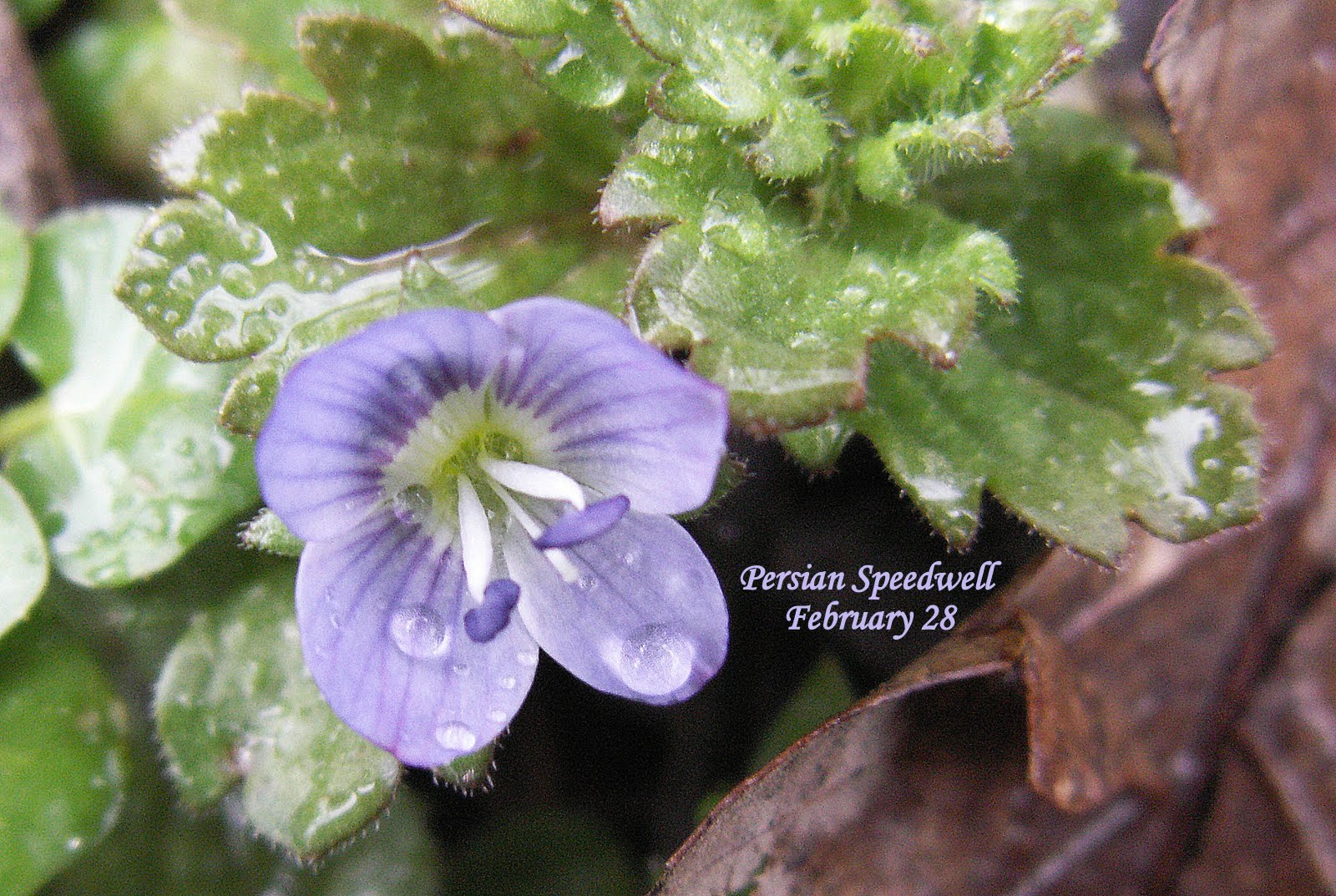
Persian Speedwell

One of the first signs of spring in Wildwood is often overlooked.
It is tiny and underfoot.
A close-up photo makes you think that it is large but,
don't let the camera fool you!


Persian speedwell (Veronica persica) is a ground cover that is plentiful in Wildwood.
It blooms along the bike path, in grassy areas, and almost anywhere there
is enough sunshine for it to flower. Another speedwell that is similar to it 
is called ivy-leaved. You have to take a close look to see the differences between them.
(Be sure to notice the leaves.)


Ivy-leaved Speedwell (Veronica hederifolia) will soon also be flowering.
When looking for spring flowers, be sure to take a close look at the
tiny flowers as well as the showy ones.
Carry a magnifying glass with you!