Thursday, September 27, 2012

Trail Repair in Wildwood

While walking along the bike path early in September, I saw a truck pulling a trailer. Trucks are not usual sights in the middle of Wildwood so I took a picture. That's what I always do when I see unusual sights in the Park.

  
 I soon began asking one of  the men questions about why the equipment had been brought into the Park. (I think that having a camera in my hand makes me more curious than usual. It also makes some folks more willing to answer my questions.) Charlie Dundas, the fellow with the beard (And yes, I agree that he looks a lot like Santa Claus!) introduced himself. He told me that he was the owner of Tri-State Company, Inc. and that he had been hired by the City of Radford to repair some of the damage that the wind storm had caused at the end of June. He and a member of  his crew began to closely inspect the tree that had almost fallen on the footbridge in the middle of the Park. He also told me that he had built the Middle Footbridge, the Grand Staircase, and trails that had stairs. I was impressed - who should know better how to repair the damage?


 The trailer and the equipment were left parked by the side of the bike path. Hmm, I thought, that Caterpillar is very different from the ones I usually see here. I got used to seeing it each day as I walked with my camera.


Then one day, I noticed that it was gone - where could it be? That question was soon answered when I passed the Outdoor Classroom shelter, heard an engine, and looked up through the trees and into the woods. There it was - on the upper trail!


Charlie Dundas waved to me from high above. I crossed the middle footbridge, walked up the stairs,
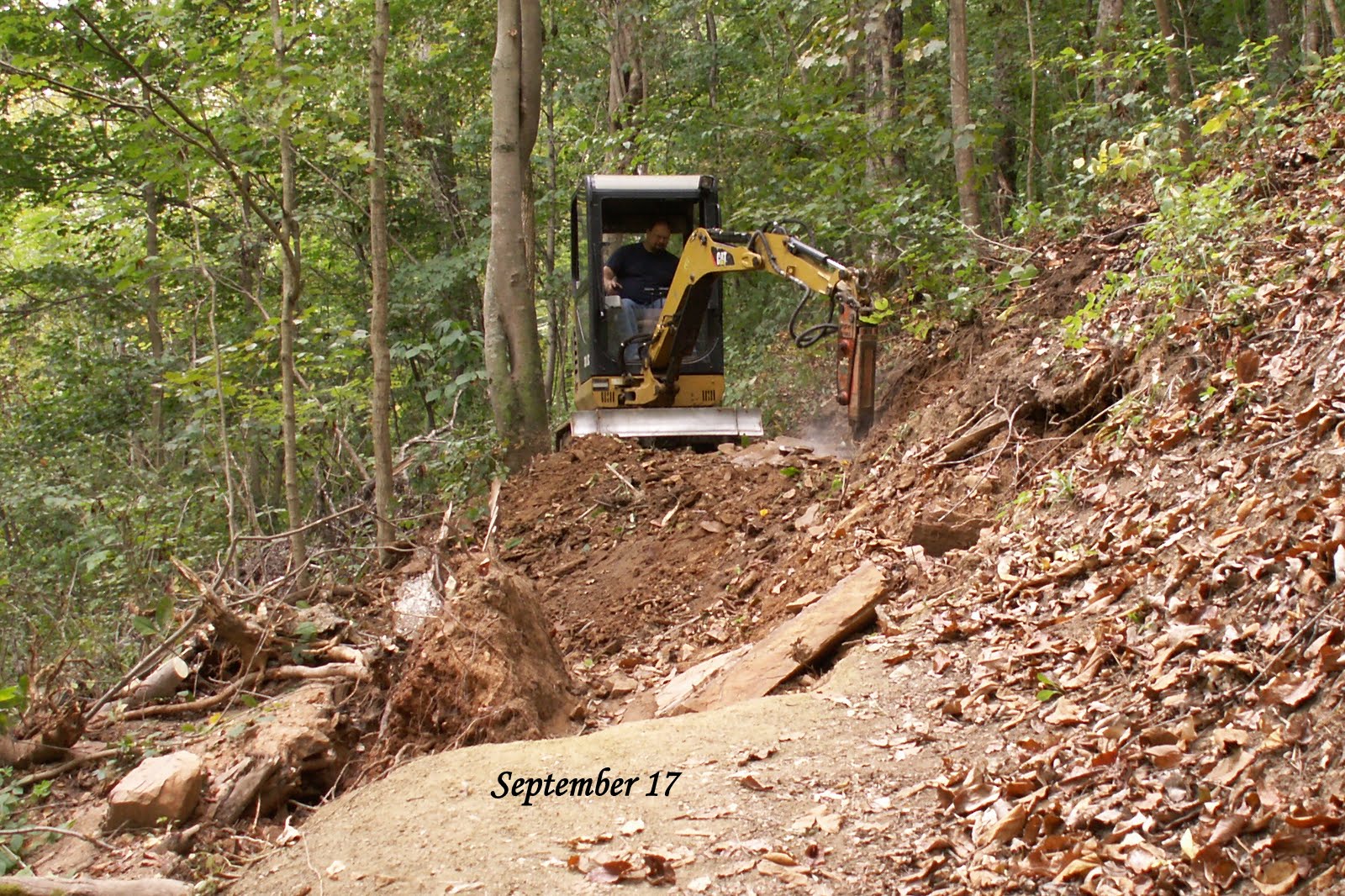
and soon saw the Caterpillar hard at work.


This was the place where the huge tree uprooted by the wind had pulled out a large portion of the trail, breaking up rocks and leaving a big ditch where the trail had been. Dirt was being rearranged as the shovel lifted out dirt and dumped in it another place. The blade on the front was then used to smooth out the area.


Charlie was watching the progress as he stood behind the machine.
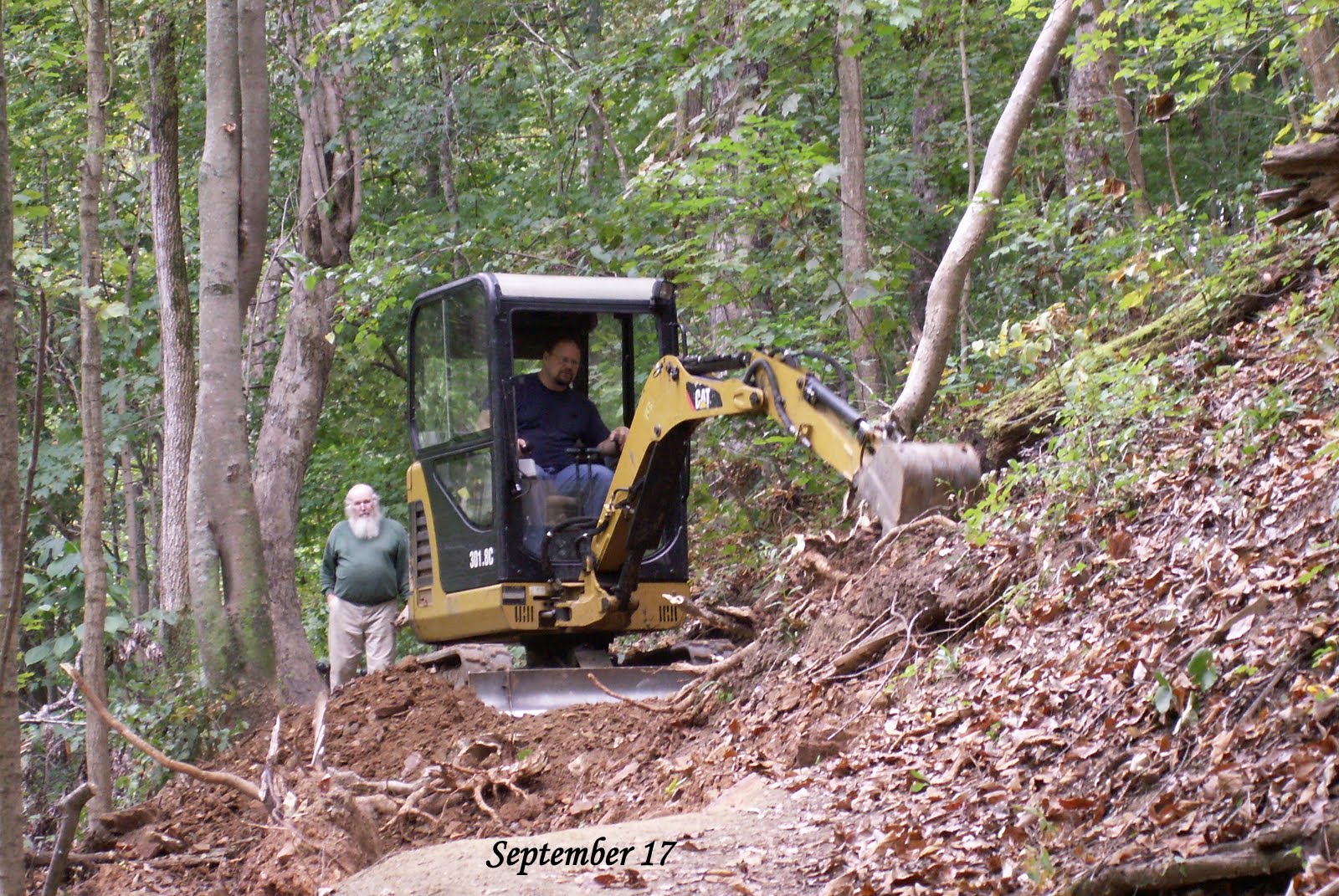


He soon was able to come across the trail to stand beside me and answer my questions. Remember, I  had my camera in my hand so I was very curious. When I asked how he got the machine up to the trail, he said that it was driven up there! The tractor wheels can be moved in or out to make the machine narrow or wide.  It is called an excavator and is powerful enough to move dirt and rocks but small enough to be driven up the trail. In addition to the shovel or bucket, there is a jack-hammer for breaking up rocks.
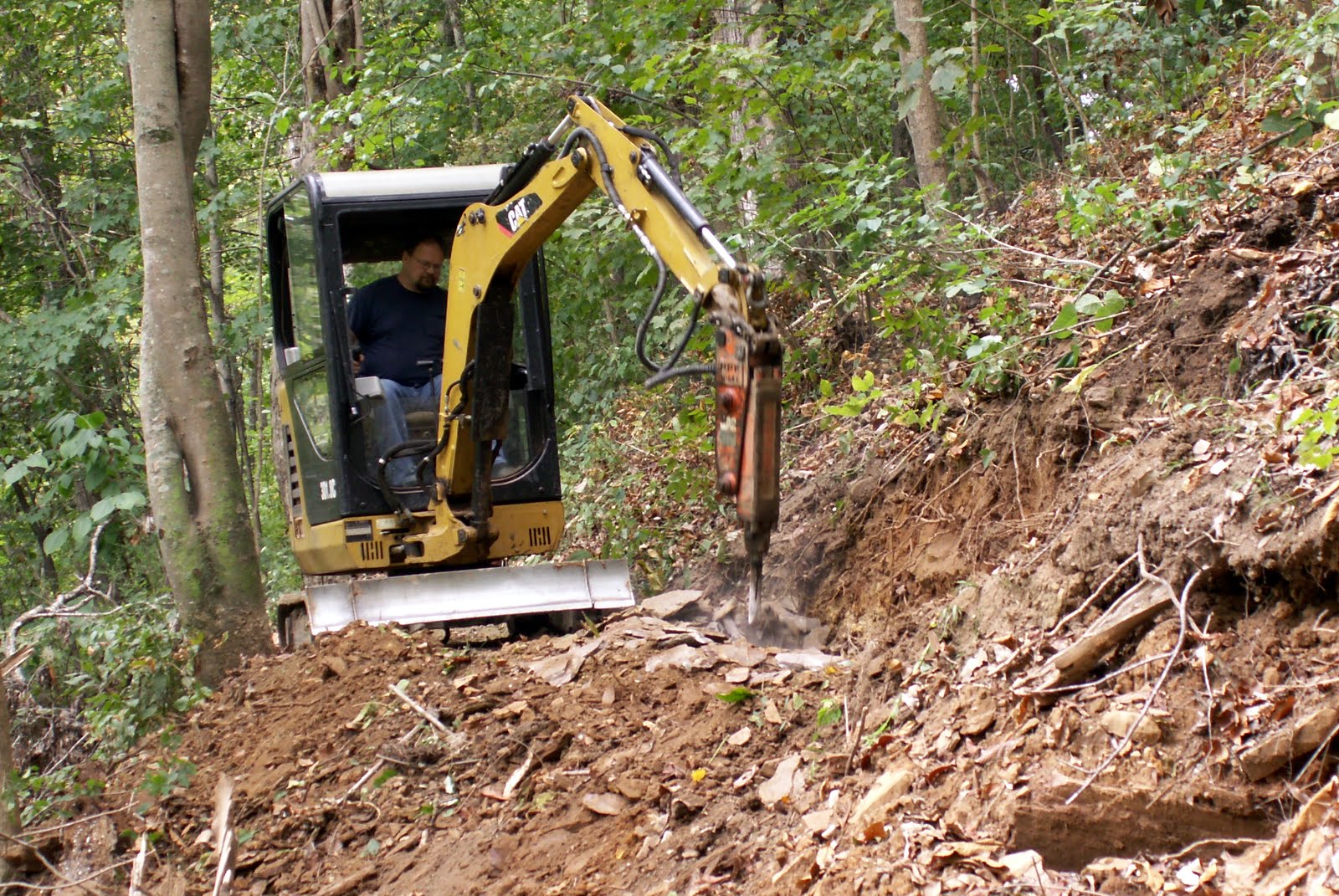


        The bucket has claws on one side that can be used to dig out trees that need to be moved.


                   Another crew member is always ready with a chain saw to cut the trees into smaller pieces.


The front attachments are designed to be changed out easily and rapidly. Well, they made it look easy, and it didn't take long. 


As we watched the trail gap begin to be smoothed out and closed up, I asked Charlie how he got started in the business of building trails and bridges and such. He said that he and  several other Boy Scouts, over a period of several years, built a 31 mile trail along the Kanawha River in West Virginia. That trail became a part of the Kanawha River Trace that will celebrate its 50th anniversary in October. After serving in the Marines, he became owner of his own company and has built and repaired trails all over the region. He specializes in being as gentle with the environment as possible. 
During our conversation he received a call that H.T. Bowling had arrived at the Main Street entrance and someone was sent to open the gate for his truck. The crew took a break from the construction work and went to conference with Mr. Bowling and his crew.
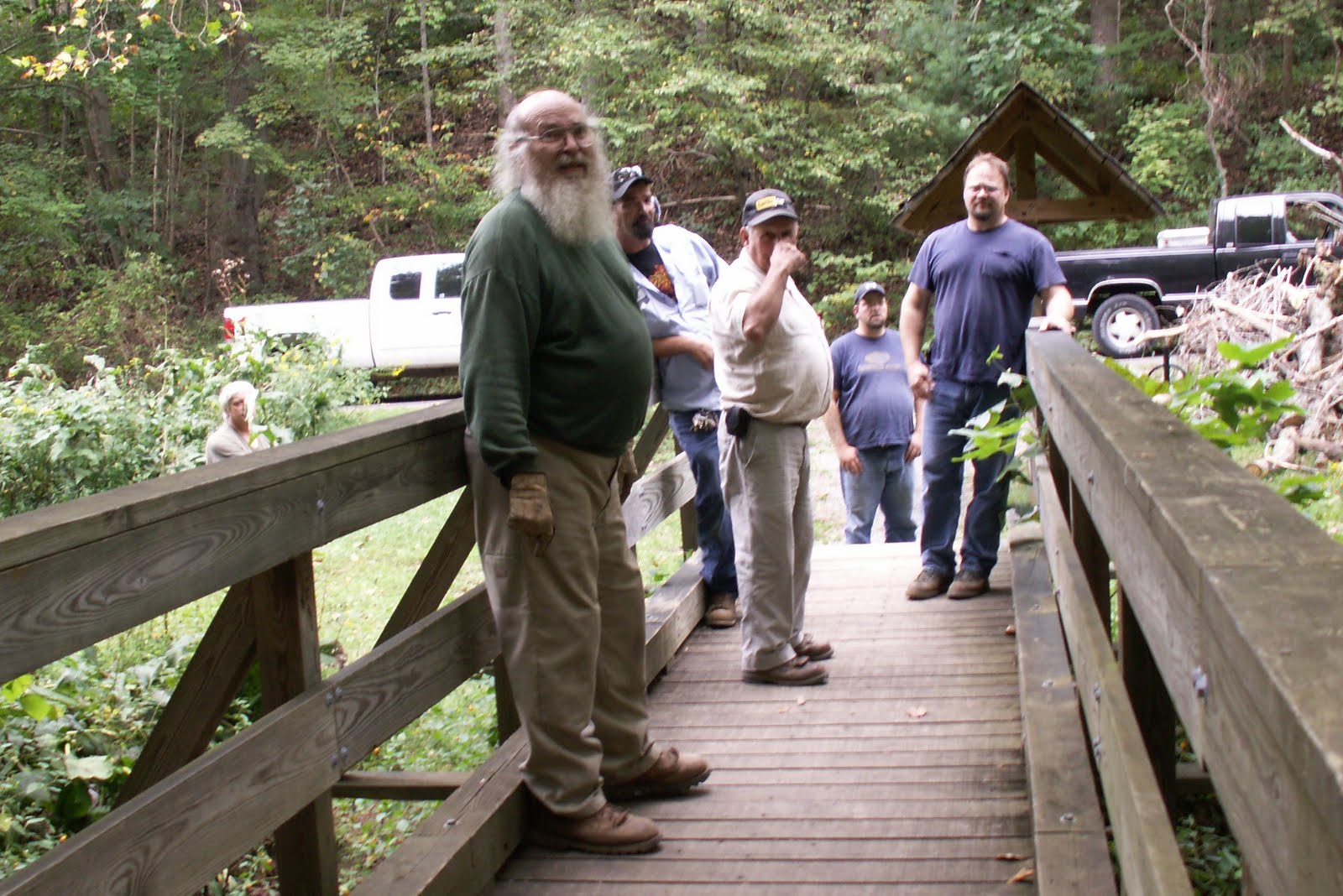

A large crane would be needed when it was time to remove the huge tree that had fallen beside the Middle Bridge and was lying tightly beside it. The crane would have to hold the tree trunk in place to keep it from slamming into the bridge and Mr. Bowling would be the expert to do that task. I was getting hungry so I said "Good-bye" to all and headed home for lunch.


Several days later, as I hiked the upper west slope trail, I saw that Mr. Dundas and his crew had completed their work there. The ground under my feet was even more level than before because the path did not have to go over big roots. The big tree at the middle bridge was still waiting to be removed.


Sunday, September 16, 2012

The Very Hungry Caterpillar(s)

I think that Eric Carle may have visited Wildwood Park before he wrote his book, The Very Hungry Caterpillar and here is why:
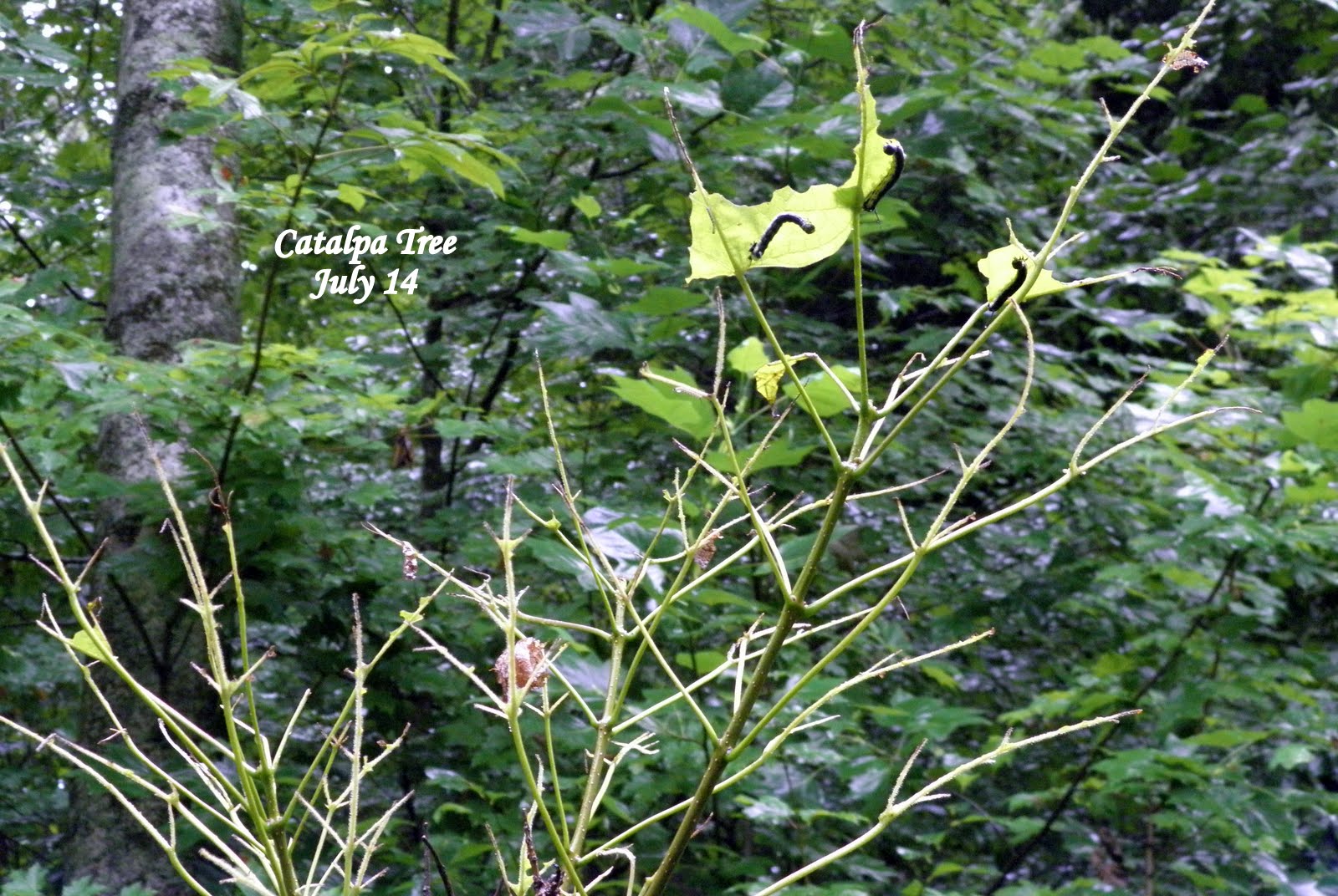
One day in July, my friend Clyde Kessler told me about some caterpillars that were feasting on the leaves of a Catalpa Tree growing at the North Bridge. So I set out with my camera to find them.
When I arrived at the bridge, I immediately saw the tree. As I got closer, I also saw caterpillars crawling on the branches. 
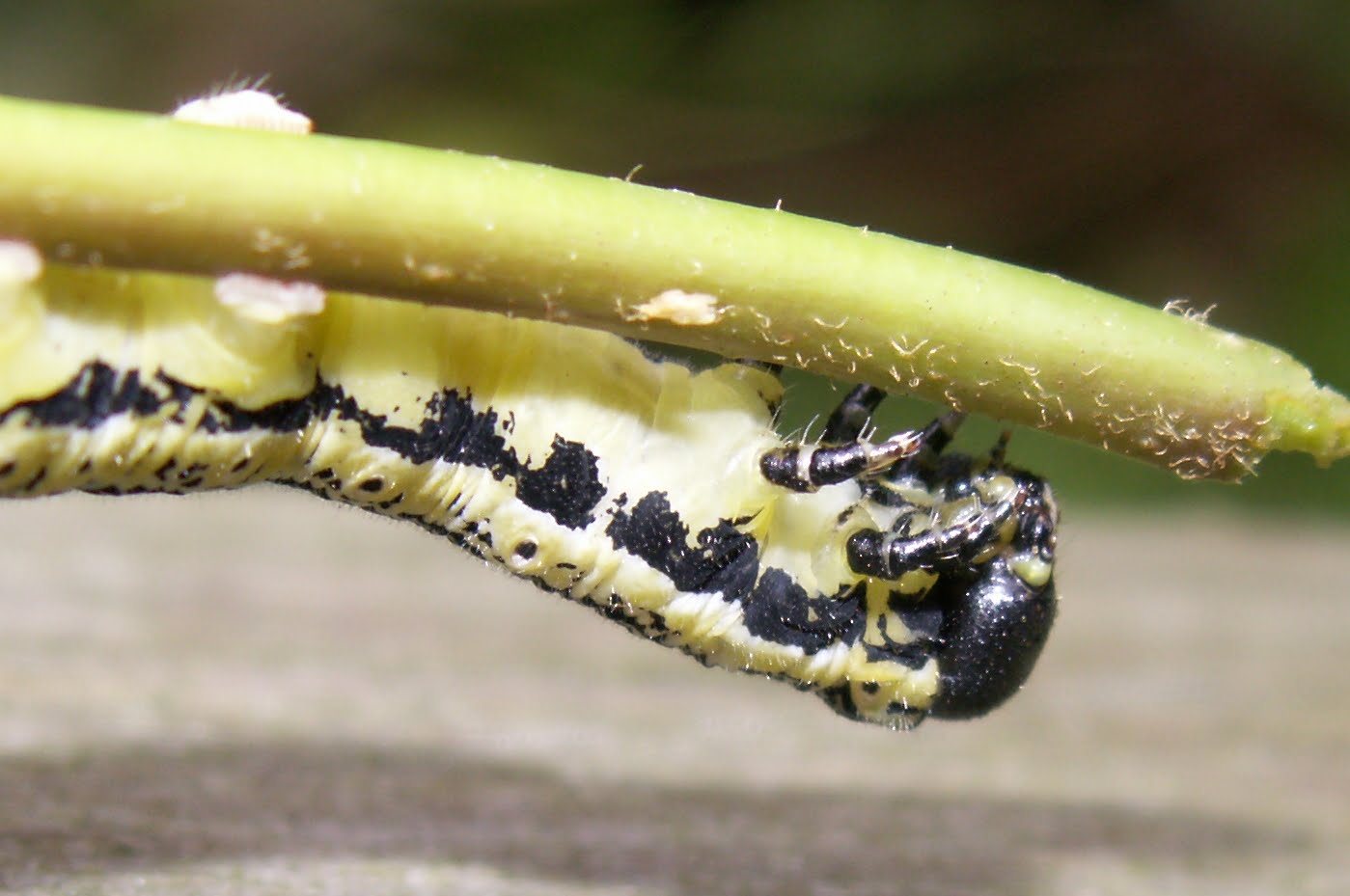
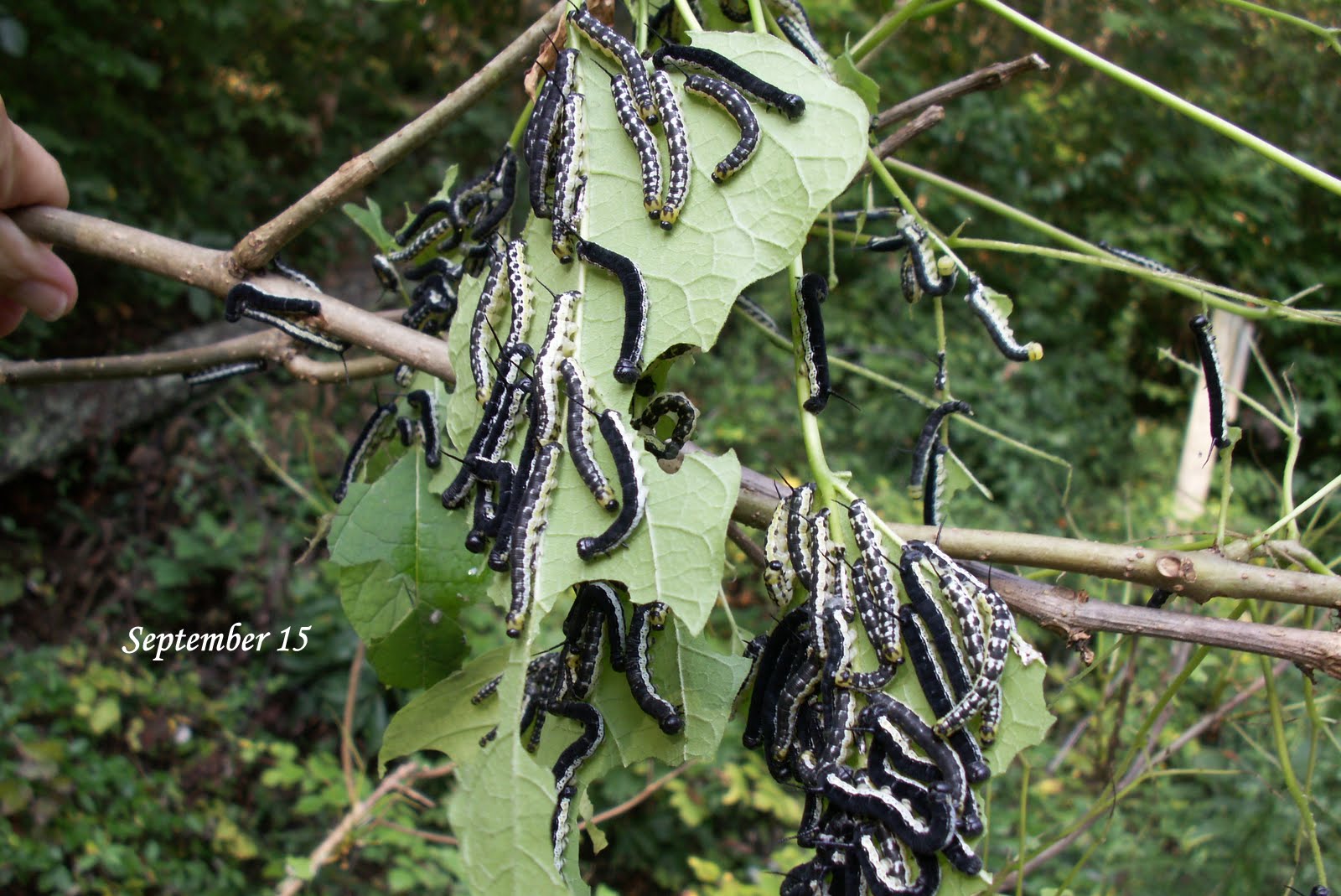
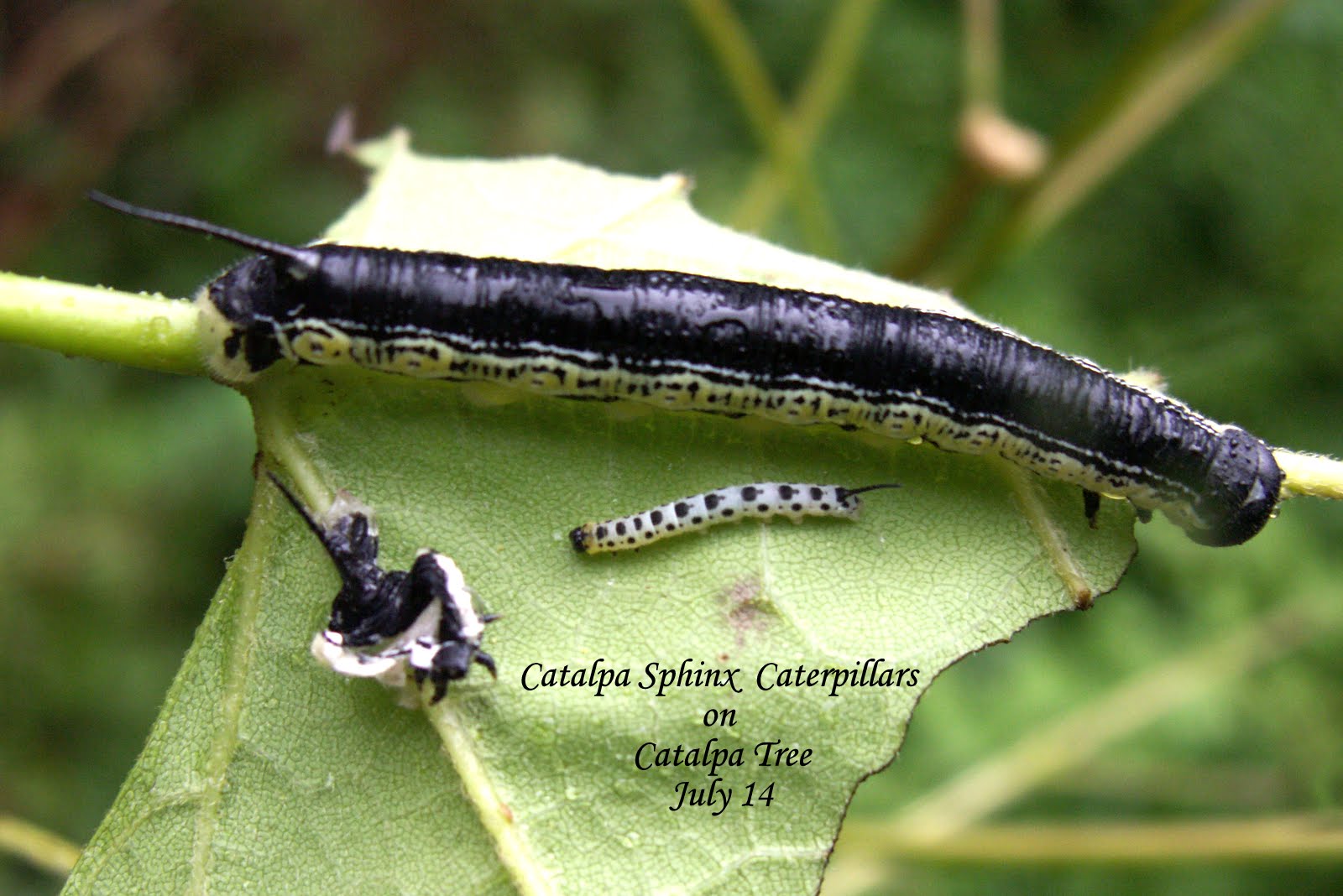
They were Catalpa Sphinx Caterpillars and most of them were large, black critters with a white stripe long their side and a long spine or horn on the back end.


The younger ones were much smaller and were mostly white with black dots. They also had spiny horns.


 Just like the caterpillar in Eric Carle's book, I could tell that these were very hungry. They were eating leaves instead of apple and oranges and ice cream, but the leaves were disappearing .


                                          The leaves had almost all been eaten...


                                                                             ...by very hungry caterpillars!


When all of the leaves were gone and there were only bare branches left, I didn't see any more cats.
However, I did keep checking on the tree as I crossed the bridge to and from the tunnel. I was very pleased to see that new leaves began to cover the twigs and branches.


Then one day in early September, I saw that the caterpillars had returned! The young ones made lovely designs as they rested on the underside of the leaves.


                                                       They were ready to feast again!


                                          And ready to grow larger and larger...


                                                                             ...as they ate more and more!


They did not stay on the bare branches after the leaves disappeared. Perhaps they knew that fishermen love to use them for fish bait.
Unlike the caterpillars in the book, these "worms" will grow up to be Catalpa Sphinx Moths instead of butterflies.


Thursday, September 13, 2012

Any Questions?

During the school year, students are often asked, "Does anyone have any questions?"

When I am wandering through Wildwood Park, I often wonder, "What's that?"
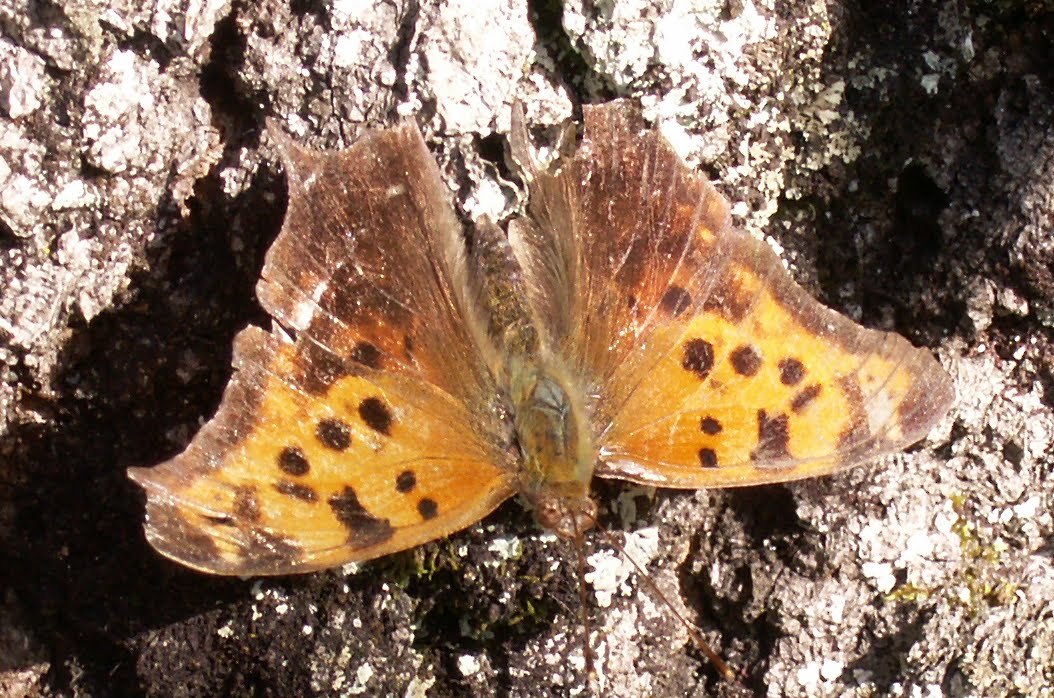
One day, I spotted a butterfly and after taking its picture, I wondered what kind it was.


On another day, I saw another of the same kind so I took its picture and still wondered
what kind of butterfly it was.


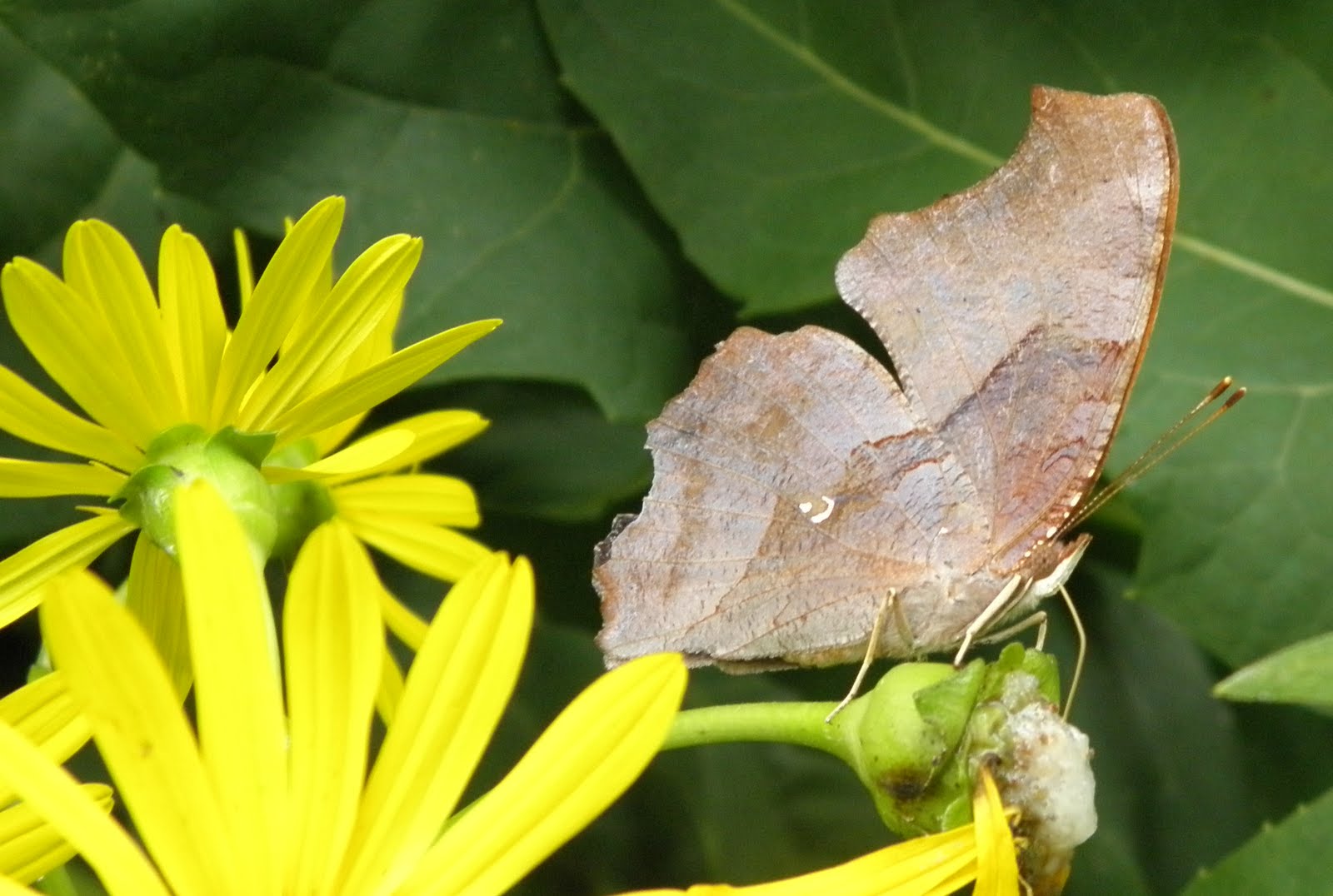
Fortunately, this one also let me see its underwing, and I was able to see two white marks that looked 
very much like a question mark turned upside down.


 Ah-ha! I had found a Question Mark (Polygonnia interrogationis)!
  This butterfly does not nectar on flowers but prefers to sip sap.


 The Question Mark above is enjoying the Cup Plants but is ignoring the yellow flowers and sipping from 
one that has lost its petals but has a sappy bud remaining. Notice its proboscis "straw".

This butterfly was so focused on the plant that I was able to focus my camera and get one more
 good shot of its identifying "tattoo"!

The Questions in Wildwood can be quite lovely!!!


Thursday, August 9, 2012

Cup Plants Burst into Wildwood!

Cup Plants are now in full flower along the creek in the center of Wildwood Park.
They are huge  - some are eight feet high! 
It looks as if the sky has turned upside down and the sun is shining up from the earth.


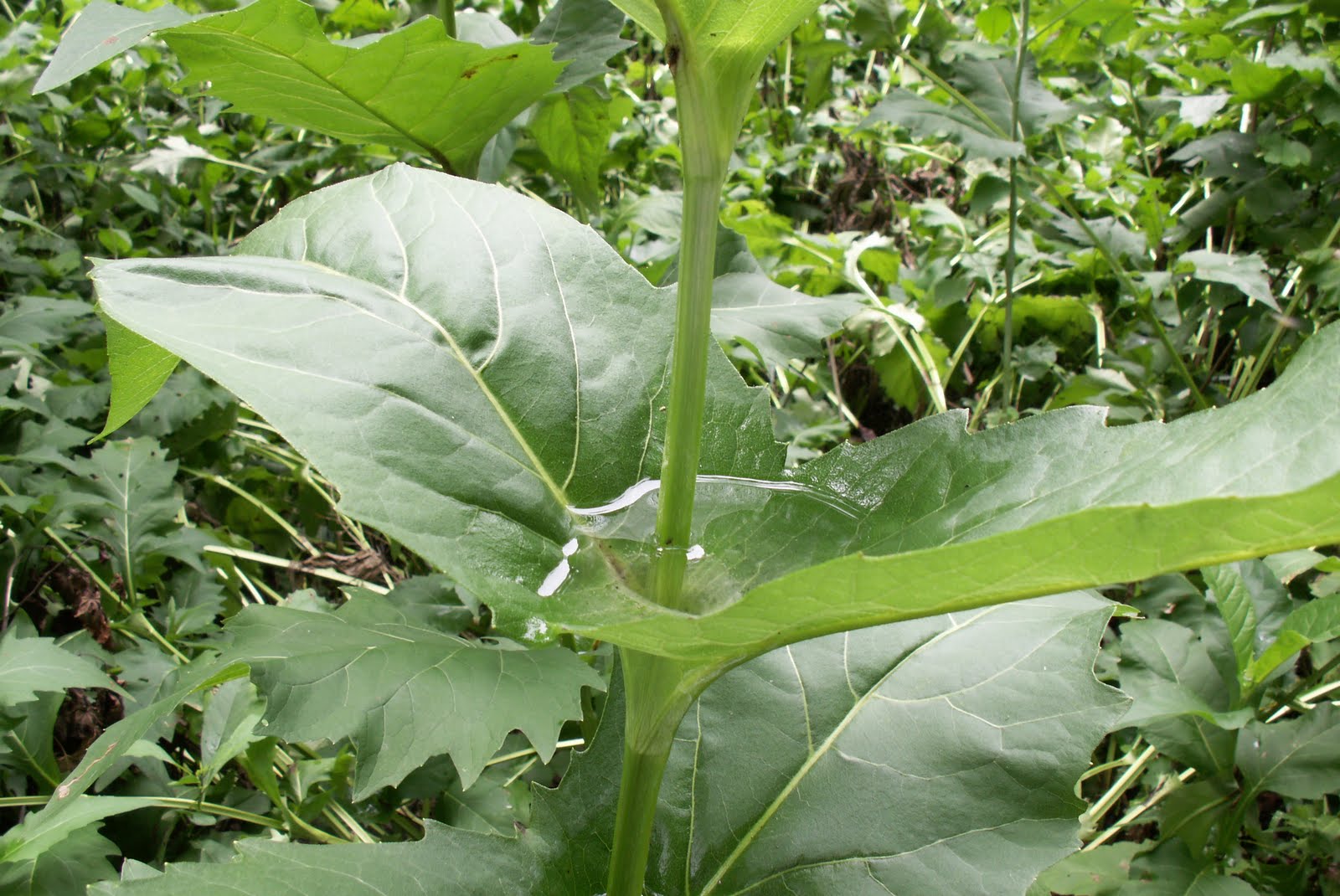
Remember that these plants get their name from the "cup" that their leaves form as the stem pushes through or "perfoliates" their center.


Many insects have found them and are fluttering and buzzing around them. 
Honey bees fill their pollen buckets. I think those buckets look more like orange boots.


A tiny Scudder's Bush Katydid nymph must be a bit overwhelmed when he finds himself at the center of a bloom.


A Thick-headed Fly stops by for a sip of nectar.


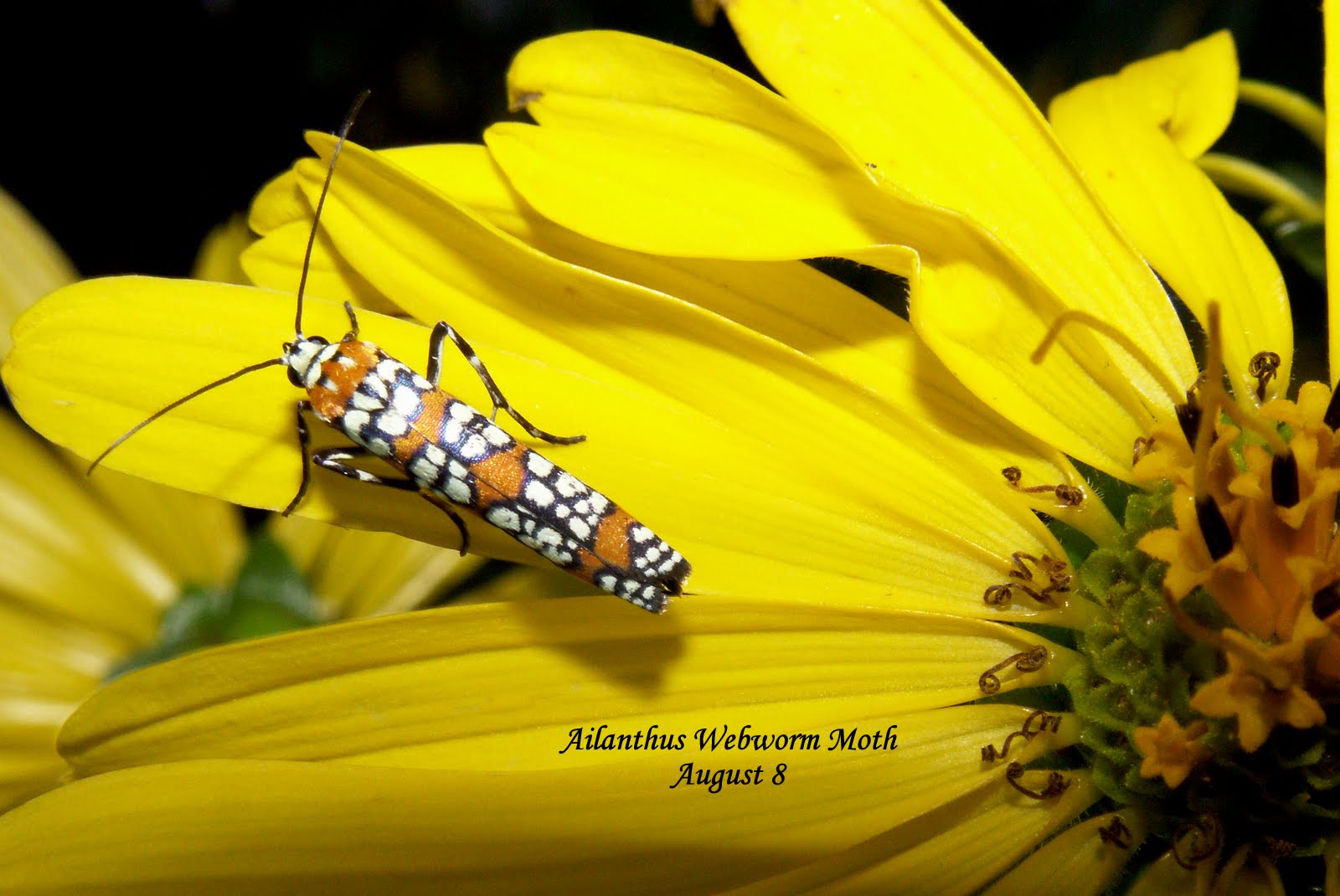
An Ailanthus Webworm Moth finds a place to rest for a while. Those moths fly during the day and are colorful enough to be beetles or butterflies - don't you think?


Our Virginia state insect, the Eastern Tiger Butterfly, loves Cup Plants


Here's the underside of a female black form Eastern Tiger.


I've tried to capture some of the beauty that has currently burst into Wildwood, but you really need to follow the main bike path through the center of the Park and see it first-hand!


Be sure to also visit the Wildwood Park website to get a look at the wide diversity of plants and critters that make Radford their home. Just click on the link below:


Tuesday, July 10, 2012

Winds in Wildwood: Bad News and Good News


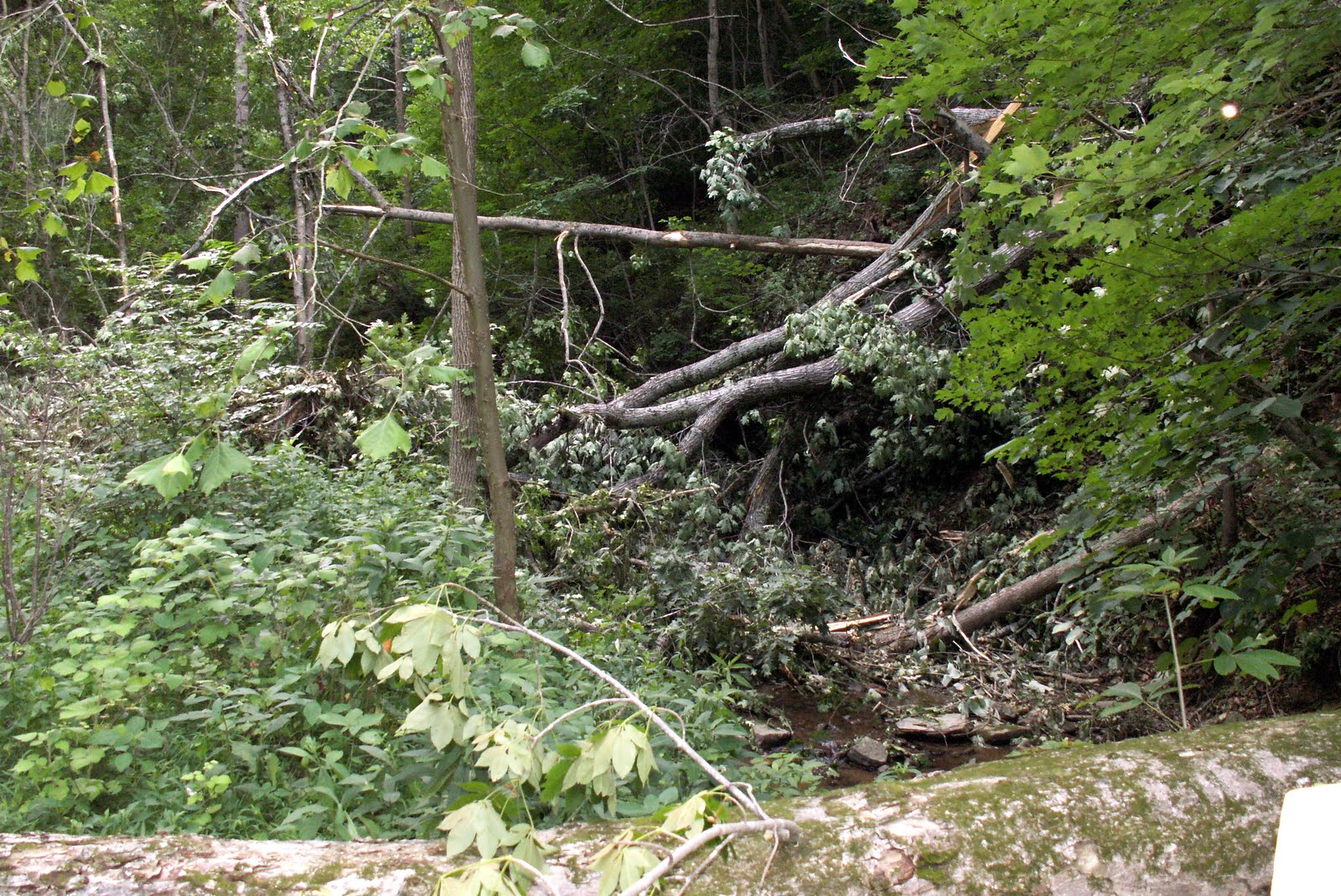
The wind storms the last weekend in June, 2012, caused quite extensive damage to the large trees that had grown in Wildwood Park for many years. Very old, very large trees were brought down with what must have been loud shattering cracks of sound. Much of this occurred on the west slope and many tree tops now lie in the creek that flows through.


As I started walking across the upper west slope at the trail head behind Bobcat Stadium, I had a more open view than usual of the bike path below because limbs and trees had been blown to the ground. 


One of the most dramatic sights was a HUGE (perhaps 10 feet in diameter!) disk of roots and dirt that met me when I came around a slight turn in the trail. 


Then I looked directly down to see that the hard dirt path under my feet had opened up just a few steps beyond to a gaping hole with large slabs of rocks on it. 


My camera could not fully capture the impact this sight made on me.

On the eastern slope, winds caused the top portion of a big tree beside the Grand Staircase to fall to the ground bringing with it a very large bee community.


Large slabs of honey comb were strewn on the forest floor as the tree splintered on impact. What a sad way for those little critters to have to break-up housekeeping.


Oh, I did promise some good news - It is very interesting and heartening to see what wasn't damaged: Before the winds, a huge old tree grew at the end of a wooden footbridge in the middle of the park. Its roots seemed to reach out to invite hikers to cross the bridge and explore the cool, dark forest. That tree was uprooted, but it fell to the side and missed hitting the bridge and a message board kiosk beside the path to the bridge! Limbs did have to be cleared from the bike path.


Losing so much of the shade that cooled the western slope will surely make a difference in the plants that grow there.  Those that thrive in less light will perhaps die out or grow in outer places. However, those that enjoy the sun’s warm rays may flower and grow hardier. The animal life will, of course, also change. 
We will have to wait patiently and observe.